


A Region That Feels Familiar Again
Across Latin America, there’s surprise at how quickly the United States has shifted to a hyper-assertive strategy in its own hemisphere. The change was telegraphed early in the new administration, declaring that U.S. foreign policy would “champion core American interests and always put America and American citizens first.” But the level of activity that followed has moved far beyond what most governments expected.
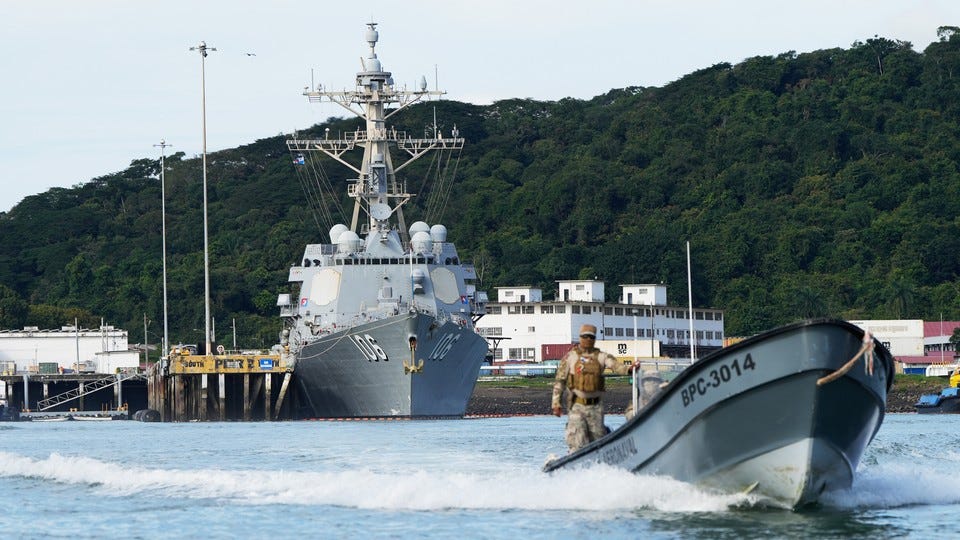
The strategy appears to rest on several clear principles. First, the United States will not tolerate territories run by cartels or porous migration corridors that it considers national security threats. Second, if a government cannot or will not address those problems, Washington will act without permission. Third, access to U.S. markets will be contingent on cooperation. Secretary of War Pete Hegseth made the message explicit: “The Western Hemisphere is America’s neighborhood and we will protect it.”
That’s why analysts have reached for historical analogies to make sense of it. Some invoke the Monroe Doctrine. Others cite Theodore Roosevelt. Yet neither frame fits neatly. The region has seen versions of this before, but not quite in this form. What, then, is the real historical pattern we’re watching resurface?
A Neighborhood on Edge
The new approach is defined by action first and explanation later. The administration designated drug cartels as terrorist organizations, enabling a wider range of intelligence and military tools. U.S. forces have carried out strikes on alleged narcotraffickers in the Caribbean. A carrier strike group now sits off the coast of Venezuela.
Even partners accustomed to hardline language are unsettled. It’s not that the United States is acting forcefully. It’s the undefined scope and improvisational feel of the campaign. Governments from Brazil to Mexico to Colombia don’t know what triggers escalation, or how long the pressure will last.
The diplomatic fallout has been sharp. Colombia, once the closest U.S. security partner in the region, has suspended intelligence sharing. The UK paused operational cooperation over concerns about tactics and human-rights risks. Leaders across the hemisphere see a White House acting on an elastic set of rules, and they know there’s a long history of Washington doing just that.
Reviving the Monroe Doctrine
In 1823, President James Monroe delivered a warning to European empires: the Western Hemisphere was no longer open to recolonization. It was a statement of separation, not domination. Crucially, the Monroe Doctrine did not give Washington authority to intervene inside Latin American states. It was a shield against external encroachment, not a blank check for internal policing.
Commentators have used the Monroe Doctrine to describe Trump’s revival of hemispheric assertiveness. But Monroe’s logic doesn’t fully explain what the administration is doing. That doctrine was about external threats and reserving the New World as a zone of non-interference. Today’s actions target internal ones, including criminal networks and what Washington considers chronic dysfunction.
Still, the analogy persists for good reason. China is now South America’s largest trading partner and a major investor in the region’s infrastructure and commodity sectors. Russia maintains intelligence and military footprints in Cuba and Venezuela. It can be argued that aggressive action is needed to implement the Monroe doctrine. Even so, another president may offer a better model.
The Real Precedent: The Roosevelt Corollary
The Roosevelt Corollary, announced by President Theodore Roosevelt in 1904, was a modification of the Monroe Doctrine to justify active American intervention. Roosevelt argued that when countries in the Western Hemisphere fail to govern themselves, the United States had a responsibility to act as an “international police power.” This gave Washington permission to intervene directly in the internal affairs of its neighbors.
Examples from that era are telling. The United States took control of customs administration in the Dominican Republic in 1905 to stabilize its finances. It supported Panama’s independence from Colombia and then secured control of the canal zone. Cold War-era interventions against communist regimes in Cuba, Nicaragua, and Grenada followed similar logic: internal instability justified external action.
Seen through that lens, the present moment looks less like Monroe and more like a revival of Roosevelt’s logic. Unilateral strikes, forward military deployments, and coercive economic measures are all being used to correct what Washington views as internal disorders in the hemisphere, with Venezuela being the most obvious example.
The Limits of History
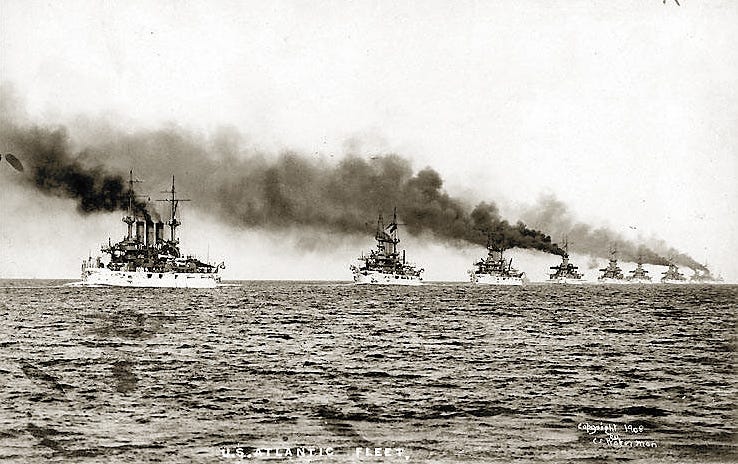
Even this comparison has limits. Roosevelt, for all his assertiveness, believed intervention should be predictable and rule-based. He constantly emphasized negotiation before force and preferred to “speak softly and carry a big stick.” His displays of power, like sending the Great White Fleet around the globe, were meant to demonstrate capability rather than brandish it recklessly.
Trump’s current approach flips that formula. It acts first, announces later, and defines American interests situationally. In this sense, the analogy that fits best isn’t Monroe or Roosevelt but the early-20th-century “banana republic” era, when U.S. forces routinely interfered in Central America and the Caribbean to install U.S.-friendly governments.
The need to place limits on this approach may be coming to a head. It’s been reported that on a September 2nd attack on an alleged drug trafficking boat, the Special Ops commander ordered a second strike after the first had already destroyed the boat. The reason was to kill two survivors in compliance with an order by DoD secretary Pete Hegseth “to kill everybody.”
Even when in a state of war, so-called “no-quarter” orders are illegal. If it’s true that the two individuals killed in the second strike were stranded, then that is a war crime. But all of these strikes are occurring outside Congressional authorization, and Latin American governments will not appreciate the U.S. military acting this aggressively.
The Shape of the New Doctrine
This isn’t Monroe or Roosevelt revived. It’s a hybrid that uses Roosevelt’s justification without his restraint, more reminiscent of Washington’s most interventionist periods in Latin America. It turns TR’s maxim on its head: not “speak softly and carry a big stick,” but “shout loudly and swing a big stick.”
The administration calls this a return to classical American principles. The reality looks closer to an imperial sphere of influence, one where the United States reserves the right to act anywhere in its neighborhood, whenever it chooses. And, increasingly, with little regard for international law.