


This piece is part of a series focused on the American Revolution in recognition of the 250th anniversary of the independence of the United States
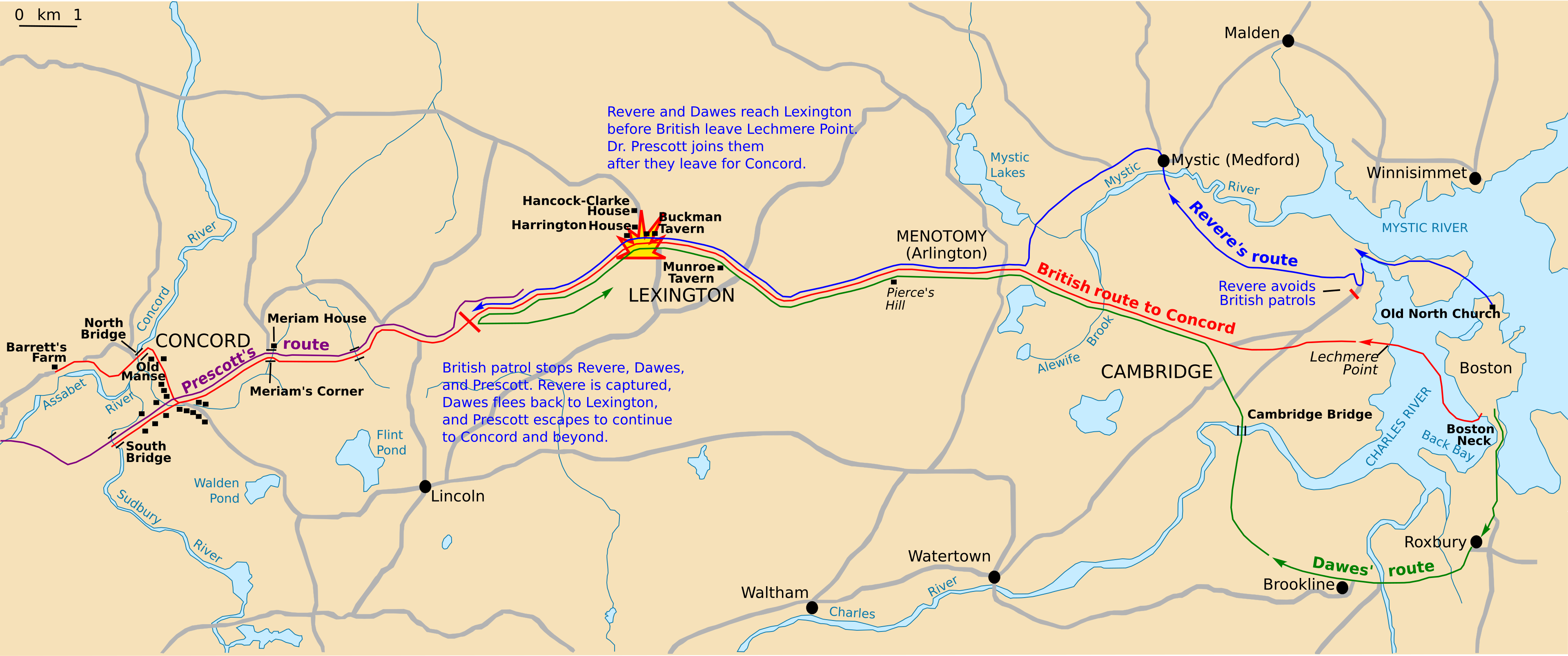
On April 19, 1775, 700 British regulars marched from Boston to the towns of Lexington and Concord to seize a colonial arms cache. It was a police action, and the Crown did not believe the colonists would fight. The Intolerable Acts of 1774 had effectively suspended Massachusetts self-government. In February of 1775, Parliament declared Massachusetts to be in a state of rebellion, and tasked a military governor with disarming growing colonial militias.


A nascent colonial intelligence network uncovered this and moved their supplies from the weapons caches at Lexington and Concord, and the militia organized to harass the British army on their return trip. On the 18-mile retreat from Concord to Boston, thousands of militiamen fired from concealed positions.
The British suffered seventy-three killed, one hundred and seventy-three wounded, and twenty-six missing. The colonists lost fifty killed and thirty-nine wounded. The most powerful army in the world had been bled by farmers with muskets. And they set the stage for a grueling guerilla campaign that defined the 8 years of the American Revolution.
It was not just the colonist’s bravery that led to this result. Four conditions were in place that British military professionalism could not overcome. The first was terrain. The militia knew every road, farm, and tree line between Concord and Boston. The British marched in formation through countryside that functioned as a shooting gallery. The second was distributed command. The self-organized militia had no single commander to capture, and no central arms depot to destroy.
The third was cost asymmetry. For the colonists, this was an existential fight on home soil for their rights as Englishmen. For the British, it was a colonial enforcement problem across an ocean. The two sides were not absorbing comparable costs toward comparable stakes. The fourth was political illegitimacy. The British were not defending their own territory, and every escalation produced more colonial recruits. Within weeks of April 19, 20,000 militiamen had placed Boston under siege.
Those same conditions defined the next eight years. The Continental Army was established in June 1775, with George Washington taking command of a force based in Cambridge, across the Charles River from Boston, that was underfunded, underequipped, but fighting on home terrain. In March 1776, Henry Knox dragged sixty tons of artillery from Fort Ticonderoga to the heights overlooking Boston, a feat meant to break a nearly year-long seige. The British position became untenable, and they evacuated without a fight.
Britain won most of the set-piece battles that followed, but it did not matter. Every campaign required moving a professional army through hostile territory thousands of miles from its supply base. The war ended the same way it started. At Yorktown in 1781, Washington’s Continental Army fixed Cornwallis from the north across the narrow peninsula connecting it to the rest of Virginia, while s French fleet cut off the sea. A distributed eight-year insurgency had exhausted British will and treasure to the point where a single tactical encirclement was enough to end it.
Two modern conflicts come to mind in trying to apply the lessons from the Revolution to the present day. The Ukraine war is the best example, while the Iran war has some similarities. Russia’s February 2022 assault assumed a quick collapse of Ukrainian command, and Ukraine did not blunt this initial advance by outgunning Russia. Prepared defenses and strategic destruction of infrastructure slowed the Russians, while a distributed territorial defense force consisted mostly of small units armed with portable anti-tank missiles attacked the stalled Russian columns from concealed positions.
The defense of Kyiv and the Kharkiv counteroffensive followed the same logic as the British retreat from Concord: a superior force operating in unfamiliar terrain against a motivated defender with distributed command bled out. But, Ukraine has since demonstrated something the American colonists could not. It has achieved actual battlefield success against a peer adversary in open engagements in some cases, leading to a stalemate on a line of control that has been mostly fixed for several years. Meanwhile, drone warfare and long-range missile strikes continue to degrade Russian logistics.
On February 28, 2026, the United States and Israel launched Operation Epic Fury. Iran’s’ command-and-control infrastructure was destroyed and most of its senior leadership was killed, including the Supreme Leader. The Iranian navy was eliminated and missile capacity severely degraded. Trump declared on March 9 that the war was “very complete.” But when Iran closed the Strait of Hormuz, the entire strategic equation changed. Peace talks in Pakistan collapsed on April 12 after the Trump administration agreed to a ceasefire. The U.S. imposed a naval blockade on Iranian ports on April 13, but so far Iran has shown no indication of coming to terms.

The war is now six weeks old and unresolved. The reason follows directly from the four conditions at Lexington. The IRGC has independent command, finance, and logistics. Decapitating the formal government did not stop it. The Iranian regime is fighting at home for survival, while the U.S. is managing a regional policy problem on a political clock. The cost each side is willing to absorb is not comparable. The fact that the U.S. backed off after Trump threatened a ground invasion shows the limits of the cost they will absorb.
The lesson of April 19, 1775 is not that small forces can always beat large ones. It is that military superiority becomes less decisive when the conditions for asymmetric resistance are in place and the political objective requires more than destruction. Violence and political compliance are not the same currency.
The question for any large power thinking about using force against a weaker adversary on their home terrain is not whether it can win militarily. It is whether military victory produces the political result it needs, and at what cost over what timeline. From the Ancient Greeks repelling the advances of the Persian Empire to the Vietcong pushing the U.S. out of Southeast Asia, to every successful anticolonial revolution, history has not been kind to the side that did not think seriously about this question.