


For much of the past year, the dominant narrative about the Ukraine War has been stalemate with steady advances by Russia. The front lines have hardened and advances are measured in small increments. But that label obscures what is actually happening.
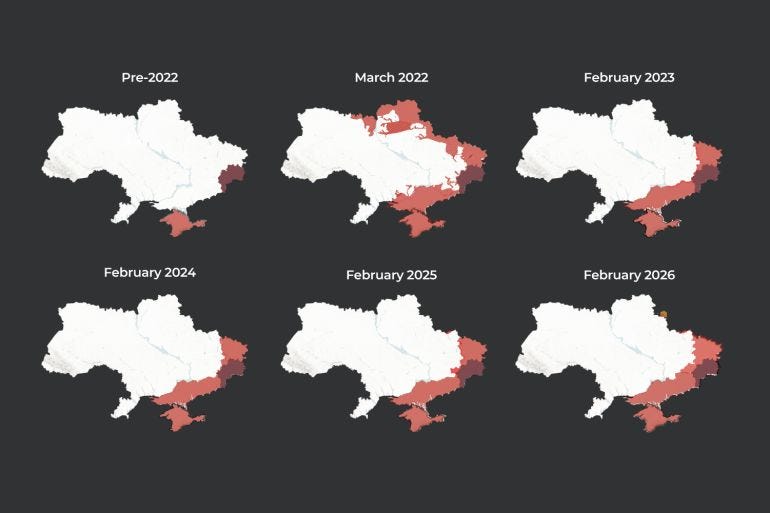
Since the major lines stabilized after Ukraine’s counteroffensive phase in Fall 2023, Russia has captured roughly an additional 1% of Ukrainian territory at the cost of over one million casualties. The battlefield has not produced decisive movement in Moscow’s favor. Instead, it has settled into a costly grind.
Ukraine has continued some offensive activity. It has struck Russian logistics hubs, energy infrastructure, and military production facilities over 1000 miles behind the front. In the Black Sea, sustained Ukrainian pressure forced Russian naval assets to pull back from positions once thought secure, allowing commercial shipping routes to reopen. Small territorial gains have occurred in localized sectors, though the broader frontline remains largely static.
Diplomacy continues in parallel. Contacts and negotiations between Ukraine, the United States, and Russia have not produced a settlement, but they show that all sides are positioning for a longer contest. Russia has shown its not interested in a deal right now, with missiles still raining down on Ukrainian civilians and the infrastructure they depend on.
Kyiv wants security guarantees and to give up no additional territory. European states are increasingly central to those discussions. Washington remains influential, but it no longer defines the conversation alone.Russia’s position has changed as well. Moscow entered the war expecting rapid gains and sustained economic leverage over Europe. Instead, it has made limited territorial progress at high cost.
Oil revenue still flows, but often at discounted prices, and even that is declining with U.S. pressure on buyers such as India. The longer the war drags on without major gains, the harder it becomes for Moscow to claim momentum. A war that produces little new territory and steady financial strain does not strengthen a negotiating hand.
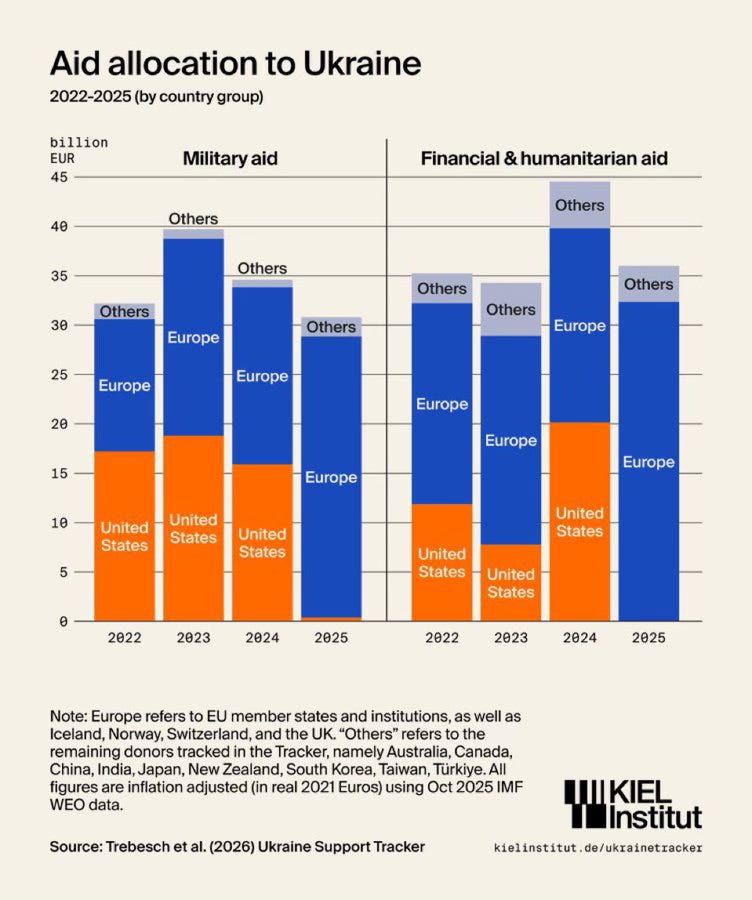
Against that backdrop, the political structure supporting Ukraine is shifting. For two years, American aid functioned as the backbone of the Western response. Advanced air defense systems, long-range weapons, intelligence coordination, and financial packages moved through Washington first. European states supplemented that support. The pace of assistance often tracked a sympathetic Biden administration.
The shift is no longer about delay. It is about structure. Direct U.S. aid has been suspended. Washington is not moving large congressional funding packages. Instead, it is permitting weapons sales from American defense manufacturers, financed by European governments and Ukraine itself. That arrangement changes the center of gravity. The United States still controls export approvals and retains industrial capacity, but it is no longer carrying the financial burden.
That shift forces a different kind of planning. Europe cannot assume American underwriting. It must organize its own defense. There has been an assumption that Europe was not capable of this. But that logic is based on the strategic picture that existed before the Ukraine war. European states have national interests that were suppressed by an alliance system designed to do exactly that in the wake of two destructive world wars largely caused by European states.
NATO was designed to, as it was famously put by the first NATO secretary general Hastings Ismay, “To keep the Russians out, the Americans in, and the Germans down.” The U.S. took charge of security and facilitated decolonization of the remaining European empires.
Europe never developed a significant arms industry or pulled its weight in NATO, because it never had to. With US support in question, the interests of Europeans are reasserting themselves in the face of a Russian threat, and combined they have more than enough resources to protect those interests themselves.
Germany’s rearmament commitments are moving from announcement to implementation, and its working with France and the UK on a potential nuclear umbrella. The European Union has expanded joint procurement and financing tools to support defense production. Nordic and Eastern European states are increasing military spending. Poland is building one of the largest conventional forces in Europe. There is now open recognition that Europe will have to take charge of its security.
Inside alliances, leverage flows from necessity. Influence comes from being essential to action. For much of this war, the United States occupied that position. Control over advanced systems and funding translated into influence over timing and escalation. Washington could shape how quickly capabilities arrived and under what conditions.
If Europe can now fund and arm Ukraine with less dependence on U.S. appropriations, that dynamic changes. European governments are asserting their interests more openly and building the capacity to act even if American politics slows support. Influence inside the alliance becomes more negotiated and less assumed.
The United States retains significant military weight and political influence. But it cannot define the terms alone. When supply becomes shared, influence becomes shared. NATO remains intact. American forces remain deployed across Europe. Collective defense commitments are unchanged. Yet dependence is decreasing.
The war continues. Russia has failed to translate attrition into decisive territorial gains, and its room to maneuver is shrinking. Ukraine has adapted to impose steady costs rather than chase dramatic breakthroughs. Europe is expanding its defense base while diplomatic channels remain open. The front may appear static. The balance of leverage is not. In an alliance built on capability, the question is no longer who is strongest. It is who is indispensable.