



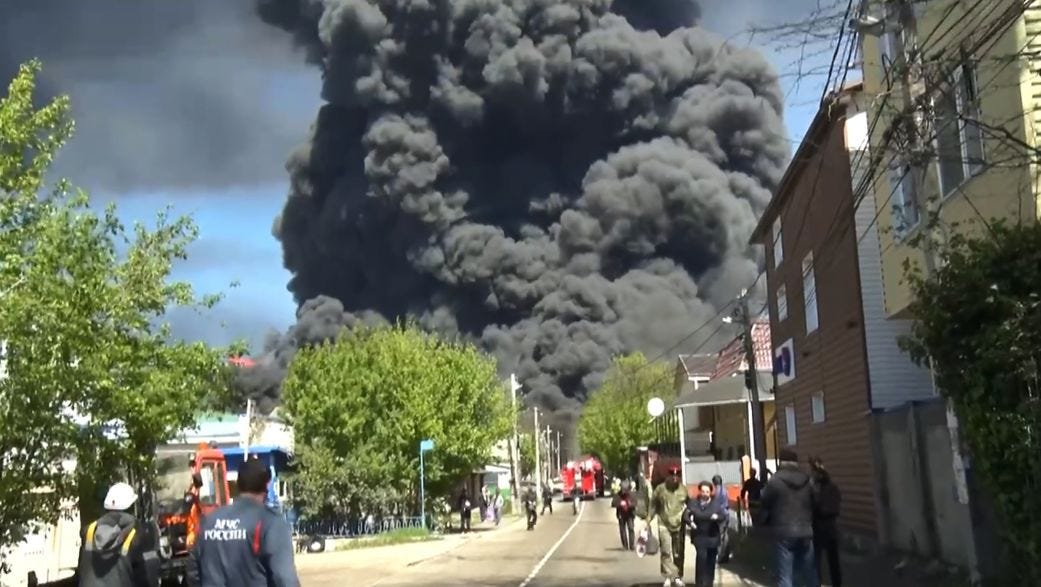
When Ukrainian Security Service drones struck the Lukoil refinery at Perm on April 30, 2026, they had flown more than 1,500 kilometers inside Russia. It was the second consecutive day Kyiv had reached that deep into Russian territory. Russian air defenses, designed for supersonic missiles, were powerless against a swarm of cheap propeller-driven aircraft built from off-the-shelf parts.
The previous piece in this series argued that America is losing the most important military race of our time because its procurement system cannot keep pace with the speed of unmanned warfare. Procurement was the symptom. The implications are broader: a UAS revolution that has quietly demolished three foundational assumptions of the Post-War international order.
Since the Russian invasion of Ukraine in 2022, Ukraine has become a laboratory for the future of conflict. Russia launched 54,538 Shahed-type drones at Ukrainian targets in 2025 and is on pace to exceed 67,000 in 2026. Ukraine responded with an unprecedented defense industrial mobilization . Starting with seven drone manufacturers, Ukraine now has more than 500, producing roughly four million drones a year, more than the rest of NATO combined.
Drones have broken the eighty-year-old assumption that offense was expensive and defense, at scale, was cheaper. Ukraine built 100,000 interceptor drones in 2025 alone, at $1,000 to $3,500 per unit. Last winter those drones accounted for more than 70% of Shahed interceptions over Kyiv, freeing scarce Patriot missiles, which cost over $3 million each, for the ballistic missile threats they were actually designed to stop.
$400 drones routinely destroy Russian T-90 tanks valued at $4.5 million; in March, one took down a $16 million Ka-52 attack helicopter near Pokrovsk. Three of Ukraine’s lost F-16s, donated aircraft worth roughly $30 million each, were brought down during Shahed intercept missions that cost Russia a few thousand dollars each,
Non-state actors now produce impacts on the battlefield that were previously reserved for well-funded militaries. Houthi drones costing $20,000 each disrupted a Red Sea corridor carrying roughly $1 trillion in annual trade. Container traffic through the Suez Canal fell 90% between December 2023 and March 2024.
In Sudan, a drone war continues between the regular army and the paramilitary Rapid Support Forces. The Laws of Armed Conflict assume uniformed combatants and identifiable command authority. They have nothing useful to say about a Houthi militant launching an Iranian-designed drone from a Toyota pickup truck.
Drones have also broken the perception of safety inside a nation’s borders. In June 2025, Ukraine’s Operation Spiderweb used 117 drones smuggled into Russia in shipping containers to strike five strategic airfields over a thousand miles away, destroying or damaging roughly a third of Russia’s long-range bomber fleet with weapons that cost about $2,000 each.
On September 9–10, 2025, at least 19 Russian drones crossed into Polish airspace, prompting Poland to invoke Article 4 of the North Atlantic Treaty, the first NATO ally to fire shots at Russian military hardware over its own territory since 1945. Romania, another NATO member, has logged seven incursions in the first four months of 2026 alone, and similar violations have spread to the NATO member countries of Latvia, Lithuania, Estonia, Denmark, Norway, and Germany.
NATO’s Article 5, the alliance’s foundational red line, now must grapple with a question its drafters never imagined: how many $20,000 drones falling on a member state’s territory constitute an armed attack? Poland and Romania, which are both pushing for a “drone wall” along NATO’s eastern flank, are demanding the alliance answer in advance.
Export-control frameworks such as ITAR, the Missile Technology Control Regime, and the Wassenaar Arrangement were built to keep sensitive components inside a narrow group of trusted suppliers. In a world where most of a Shahed’s chips come from civilian Western electronics and its airframe is consumer-grade carbon fiber, traditional arms control architecture is obsolete.
All of these broken assumptions are now reshaping three theaters at once. In the Pacific, Taiwan has launched a drone-centric defense overhaul explicitly citing Ukraine, while Chinese planners study Ukrainian operations to prepare for drone-based defenses across the Taiwan Strait.
In Africa the Russian Africa Corps deployments and Turkish Bayraktar drone exports have filled the vacuum left by French withdrawal from Mali, Burkina Faso, and Niger, embedding Russian drone doctrine in a region where a Western military counterweight is thinnest. Finally, in the Middle East, Iran’s March 2026 closure of the Strait of Hormuz triggered the largest oil supply disruption in history. This was accomplished mostly with just the threat of drone and anti-ship missile strikes.
The Pentagon’s Drone Dominance program, a $1 billion effort to deliver 340,000 small attack drones to U.S. units over two years, is an overdue start. But as the previous piece argued, this procurement reform may be coming too late as events on the battlefield outpace it.
Non-state actors now project state-scale force, and borders and distance no longer act as a buffer for even the largest states. Despite an ocean separating the United States from its adversaries abroad, drones could soon cross that moat. Their ubiquity in delivery, photography, and now warfare exposes us, and in a globalized economy, that may be exactly what our adversaries want.
Guest contributor Armin Aryafar writes on defense procurement, emerging technology, and geopolitics. He is an FAA-certified UAS operator working in autonomous drone delivery at Zipline. This piece is a follow-up to “Too Slow to Win,” published April 13, 2026.