


The United States has destroyed most of Iran’s surface navy, degraded its missile infrastructure, and killed its supreme leader. By the traditional metrics of military power, it is winning the war. The Strait of Hormuz is still closed.
That gap is the story.
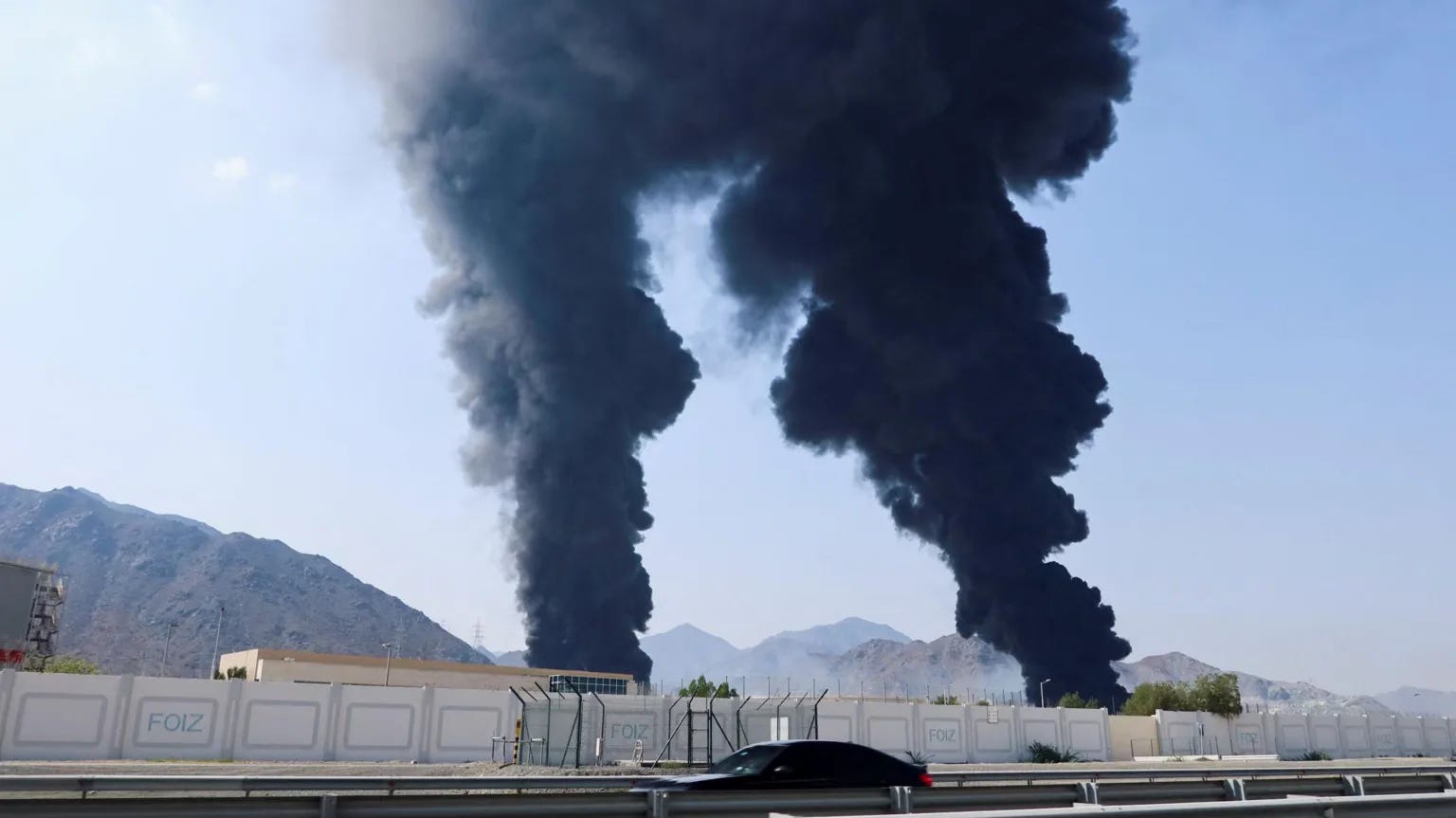
Iran’s strategy was never to defeat the American military head-to-head. No Iranian general believed that was possible, and their strategy has always been based on asymmetry. The strategy is to make the war expensive for everyone by targeting energy, shipping, and civilian infrastructure across the Gulf. The logic is straightforward: raise the price of escalation until pressure for de-escalation builds. Three weeks in, and this strategy is still in play.
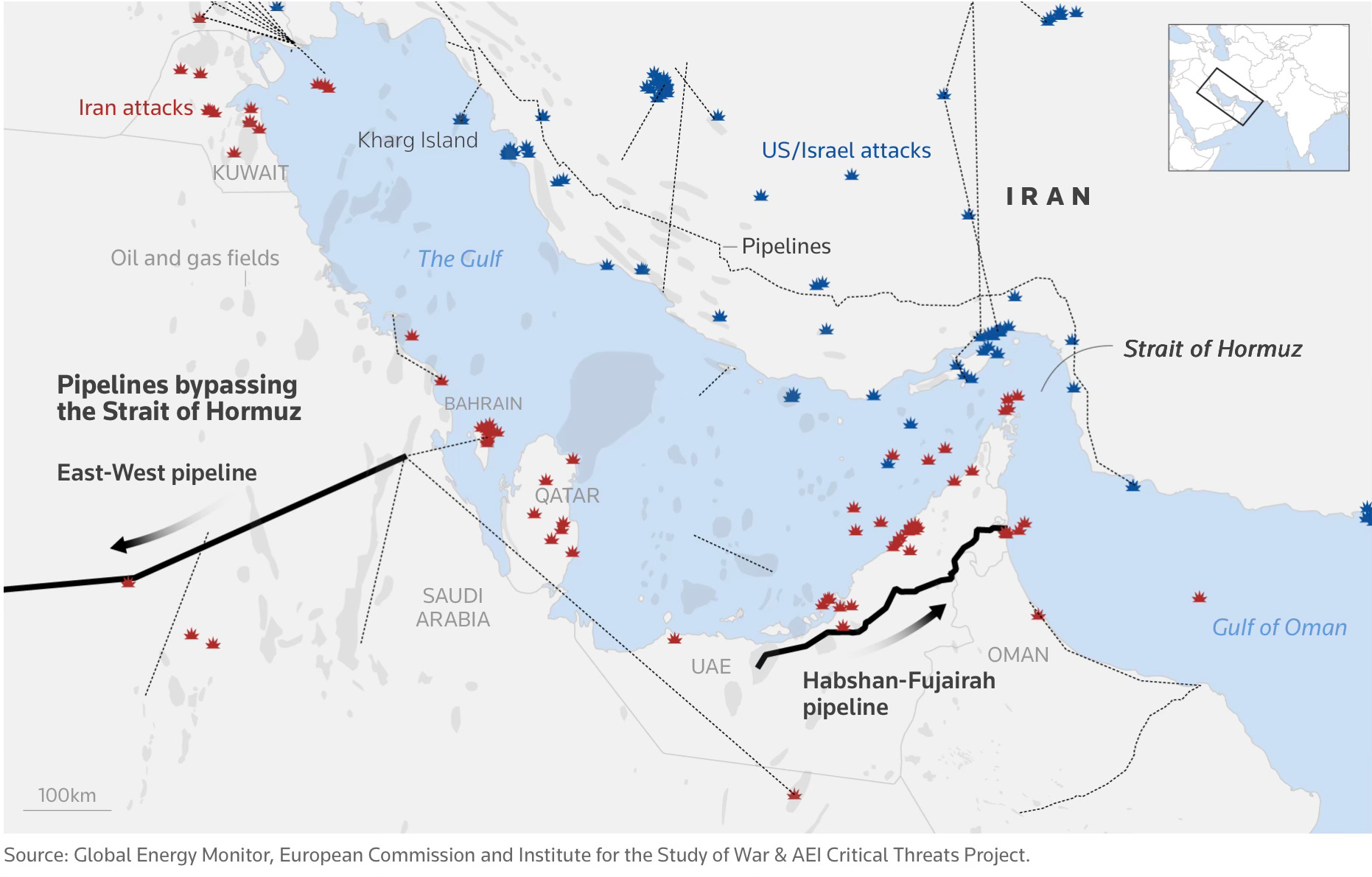
The Strait of Hormuz is the instrument. The narrow strait between Arabia and Iran handles roughly 20 percent of the global seaborne oil trade, primarily from Saudi Arabia, the UAE, Iraq, Qatar, and Kuwait. When Iran’s Revolutionary Guard declared the passage closed to American and allied vessels, it didn’t need to sink the U.S. Navy. It needed to make insurers nervous and shipping companies unwilling to accept the risk, and hit a few tankers with drones to get the point across.
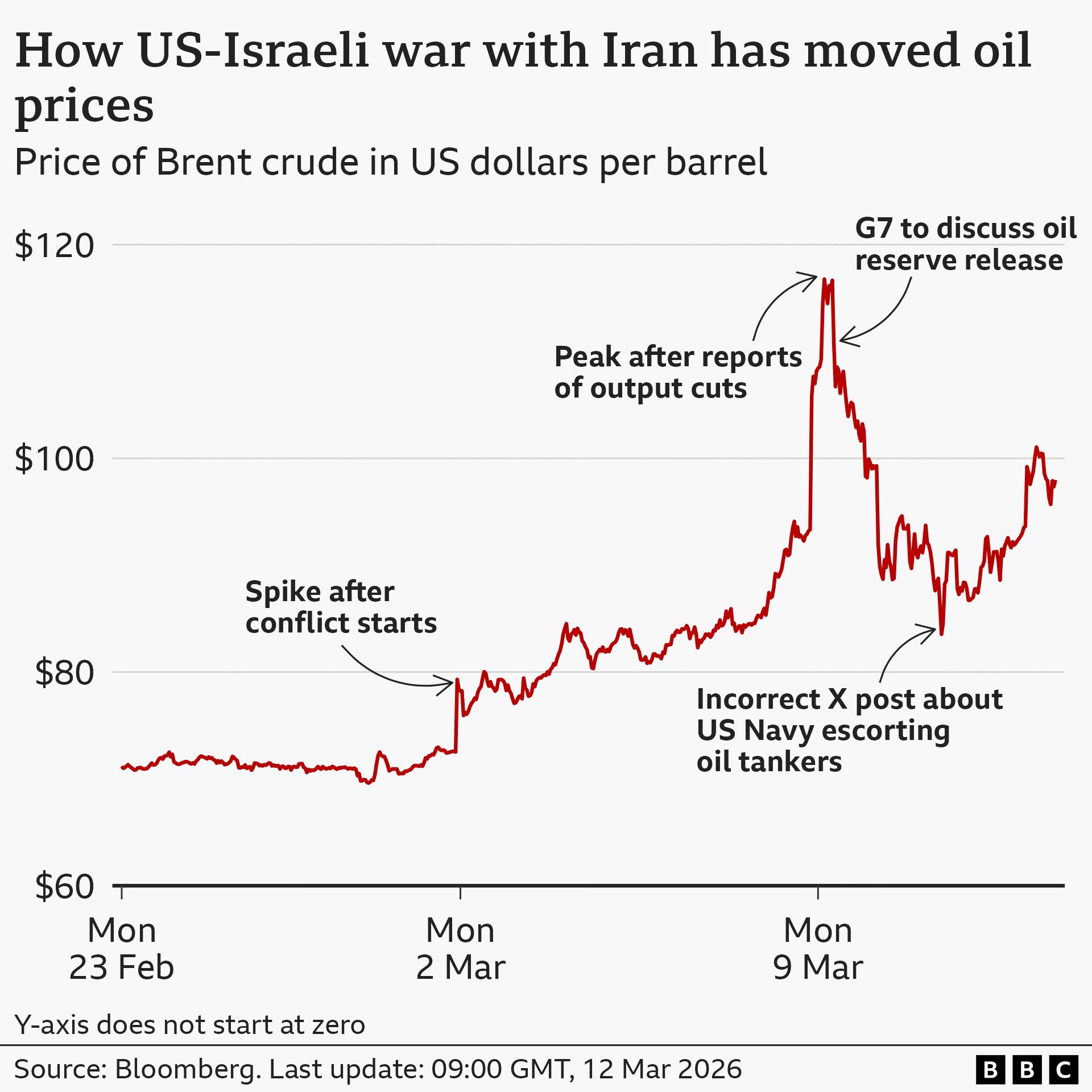
It has succeeded. Daily oil exports from the Gulf dropped by at least 60 percent in the week ending March 15, the world’s largest ever supply disruption. Oil has surged well above $100 per barrel. The economic pain is real and it is global, and it’s the result of a war the United States initiated.
Iran has also systematically targeted alternative routes. Drones struck Oman’s deep-water ports at Duqm and Salalah, which offered tankers an alternate path outside the strait. Fujairah, the UAE terminal that bypasses Hormuz, has been struck three times this month.
Beyond the energy crisis, Iran has escalated a general political crisis for the Gulf States. Besides oil, the UAE and its crown jewel Dubai are dependent on international business and tourism. Iranian drone and missile attacks have destroyed the image of safety required to sustain those industries. And Iranian strikes have had a substantive impact on degrading US military capabilities. Multiple THAAD radars, used for US missile defense, have been destroyed, along with some logistics on U.S. bases in the Middle East.
The alliance picture is the deeper wound. President Trump has demanded that NATO members, Japan, South Korea, and China send warships to reopen the strait. Germany, France, and the UK have ruled out military involvement. The message from these countries is consistent: we need the strait open, but we didn’t start this war and we won’t take the risk to help.
President Trump expressed surprise at the reluctance. He shouldn’t be. Most U.S. allies outside the Gulf opposed the operation from the start, and countries that opposed the war feel no obligation to pay its tab. And its no secret that many of our European allies are not fans of President Trump and would like to damage his political prospects in the US.
These are consequences of preventive war without a coalition. My previous piece asked whether the United States had defined its ends in Iran clearly enough and sized its means to match them. Iran, for its part, is calibrating the closure deliberately.
On March 5, the IRGC announced the strait would remain closed only to ships from the U.S., Israel, and their Western allies. India got two gas carriers through. China is in active negotiation. Iran is using access to the strait as a diplomatic instrument rewarding non-alignment and punishing alliance with Washington. That is not the behavior of a country on the verge of surrender.
The war is widening. Israel has opened ground operations in southern Lebanon against Hezbollah. Iran continues firing missiles and drones at U.S. bases and allied infrastructure from Bahrain to Jordan. Every node in Iran’s regional network has been activated. The United States is managing simultaneous pressure points across a theater that stretches from the Red Sea to the Levant, and is now pulling resources from East Asia as China surrounds Taiwan.
The administration’s position is that Iran’s military has been significantly degraded and that the disruption ends when the war does. That may be true. But the timeline is open, the end state remains undefined, and the economic cost compounds daily.
What began as a battlefield shock has hardened into a geoeconomic one. Every additional week of disruption makes recovery harder and more expensive. Iran, for its part, is a major manufacturer of drones, and even if its missile launch sites are mostly destroyed, it can still maintain the blockade of the Strait of Hormuz and continue to periodically hit US bases.
The United States has not been tactically defeated in Iran. It has won every engagement it has chosen to fight. But Iran doesn’t need to win battles to achieve its strategic objectives. It needs to hold the strait, keep its proxy network active, and wait for the economic pressure to do what its military cannot: force a negotiation on terms it can live with.
As researchers have noted at the outset of the conflict, the strategic objective of the operation remains obscure. Thatobservation has only grown sharper with time. Iran is losing the military campaign, but it holds the strait. Military dominance and strategic control are not the same thing and right now, the bill is falling on everyone except the country that started this. There are ways to secure the strait of Hormuz, but all involve greater escalation, and potentially ground troops.
The goals are unclear, the means are escalating. None of this looks promising in the long-term.
Sources
Wikipedia: 2026 Strait of Hormuz Crisis — https://en.wikipedia.org/wiki/2026_Strait_of_Hormuz_crisis
Al Jazeera: Which ships has Iran allowed safe passage — https://www.aljazeera.com/economy/2026/3/16/strait-of-hormuz-which-countriess-ships-has-iran-allowed-safe-passage-to
NPR: Trump demands NATO and China police the Strait — https://www.npr.org/2026/03/16/nx-s1-5749109/trump-threatens-nato-strait-hormuz-iran-war
NBC News Day 17 live blog — https://www.nbcnews.com/world/iran/live-blog/live-updates-iran-war-trump-reopen-strait-of-hormuz-israel-lebanon-rcna263448
CNN: EU ministers decline to expand Hormuz operations — https://www.cnn.com/world/live-news/iran-war-us-israel-trump-03-16-26
World Economic Forum: The Global Price Tag of War in the Middle East — https://www.weforum.org/stories/2026/03/the-global-price-tag-of-war-in-the-middle-east/
Columbia Center on Global Energy Policy: US-Israeli Attacks on Iran and Global Energy Impacts — https://www.energypolicy.columbia.edu/us-israeli-attacks-on-iran-and-global-energy-impacts/