


History is a very important lense to understand the world today. Scientists can run controlled experiments and make theories of why something is occurring. We cannot do that with foreign policy, so the only option is to learn what happened in the past and try to project that onto the present day. This is obviously not completely accurate; no two real-world scenarios are exactly alike. But, it’s vital to understand the history of a country as ancient as Iran to understand its government’s motivations, especially the ones that might persist across different governments.
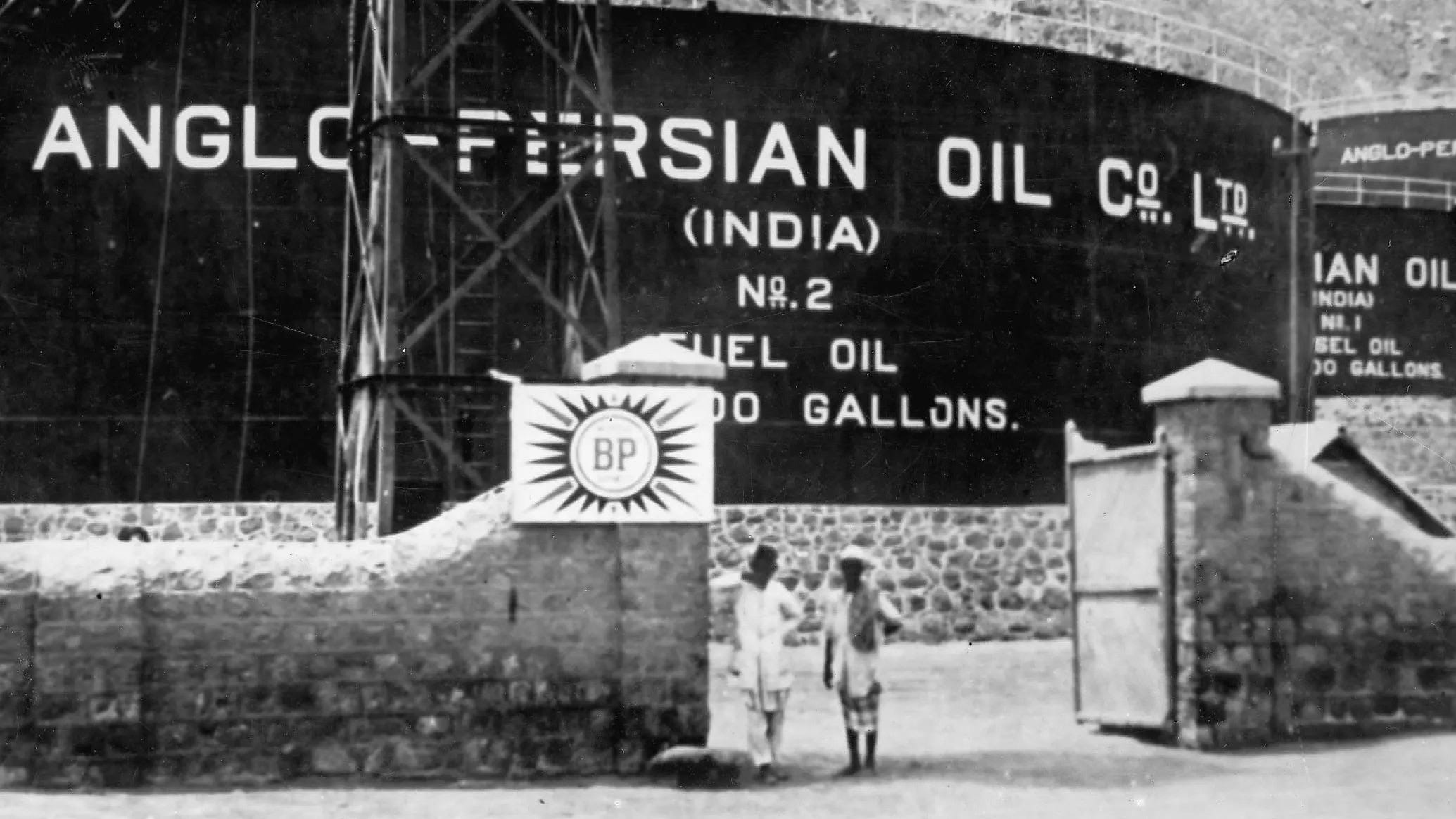
In 1901, the Iranian government granted a British businessmen a concession to explore for oil across most of the country. It was the first oil concession granted by any Middle Eastern nation to a foreign power, and it set the terms for everything that followed. When oil was struck in 1908, the Anglo-Persian Oil Company was formed. The British government became its majority shareholder. The company that would eventually become British Petroleum was, from the beginning, an instrument of British foreign policy as much as a commercial enterprise.
Iran is an ancient country, but at this point in time it increasingly resembled a modern state. A constitutional revolution beginning in 1906 had established a parliament and a prime minister serving alongside the Shah, Iran’s monarch, by 1911. The country had the architecture of self-governance. What it did not have was control of its most valuable resource. By the late 1940s, Britain was earning more from Iranian oil than Iran itself.
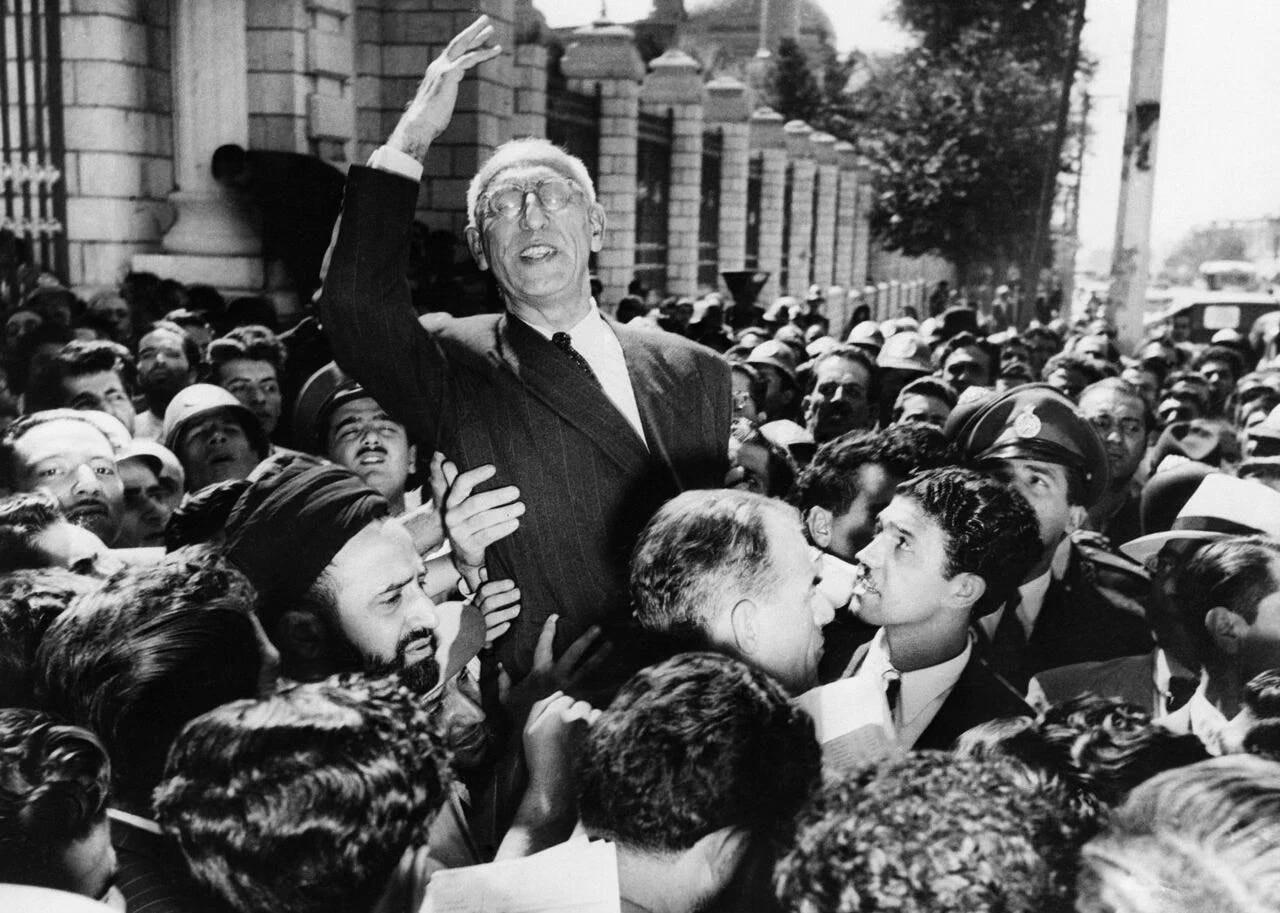
In 1951, the Iranian parliament voted to nationalize the oil industry, and the Iranian assets of the renamed Anglo-Iranian Oil Company. The prime minister who led the effort, Mohammad Mosaddegh, argued that Iran’s oil belonged to Iran and that its revenues should not be diverted elsewhere. It was the position of a democratically elected nationalist government with broad popular support. Britain responded with sanctions, a naval blockade, and broader isolation from the West. Iran’s economy collapsed.
Lobbying from the British government and American concern about political instability providing an opening for communist influence led the CIA to assist a coup plot. In August 1953, Operation Ajax overthrew Mosaddegh’s elected government and consolidated power under the Shah, who again became an absolute monarch. Around 300 people died in the fighting in Tehran. Mosaddegh was imprisoned and spent the rest of his life under house arrest, while the rest of his government was executed. The oil returned to a Western consortium.
The question of who owned Iran’s resources had been answered in the most direct terms possible. The coup did not just remove a government. It imposed dictatorship and demonstrated that Western powers would destroy Iranian self-determination to protect their access to oil. The lesson Iran drew was permanent: agreements with the West are contingent, sovereignty is conditional, and the oil is never fully yours.
The Shah ruled for 25 years with American backing. His secret police, SAVAK, established with U.S. and Israeli assistance, became a symbol of repression that reached into every corner of Iranian society. Oil revenues soared after 1973, but wealth accumulated at the top. Inequality deepened, inflation rose, and ordinary Iranians saw little of the boom. The Shah had oil wealth and American protection. He had little legitimacy.
A Shia Muslim cleric named Ruhollah Khomeini had been arrested in 1963 for condemning the Shah and the revolution that brought him to power and was sent into exile in 1964. He spent 15 years building a revolutionary theology that fused Shia Islam with anti-imperialism and a specific grievance against American interference. When the revolution came in 1979, he did not need to construct a narrative from scratch.
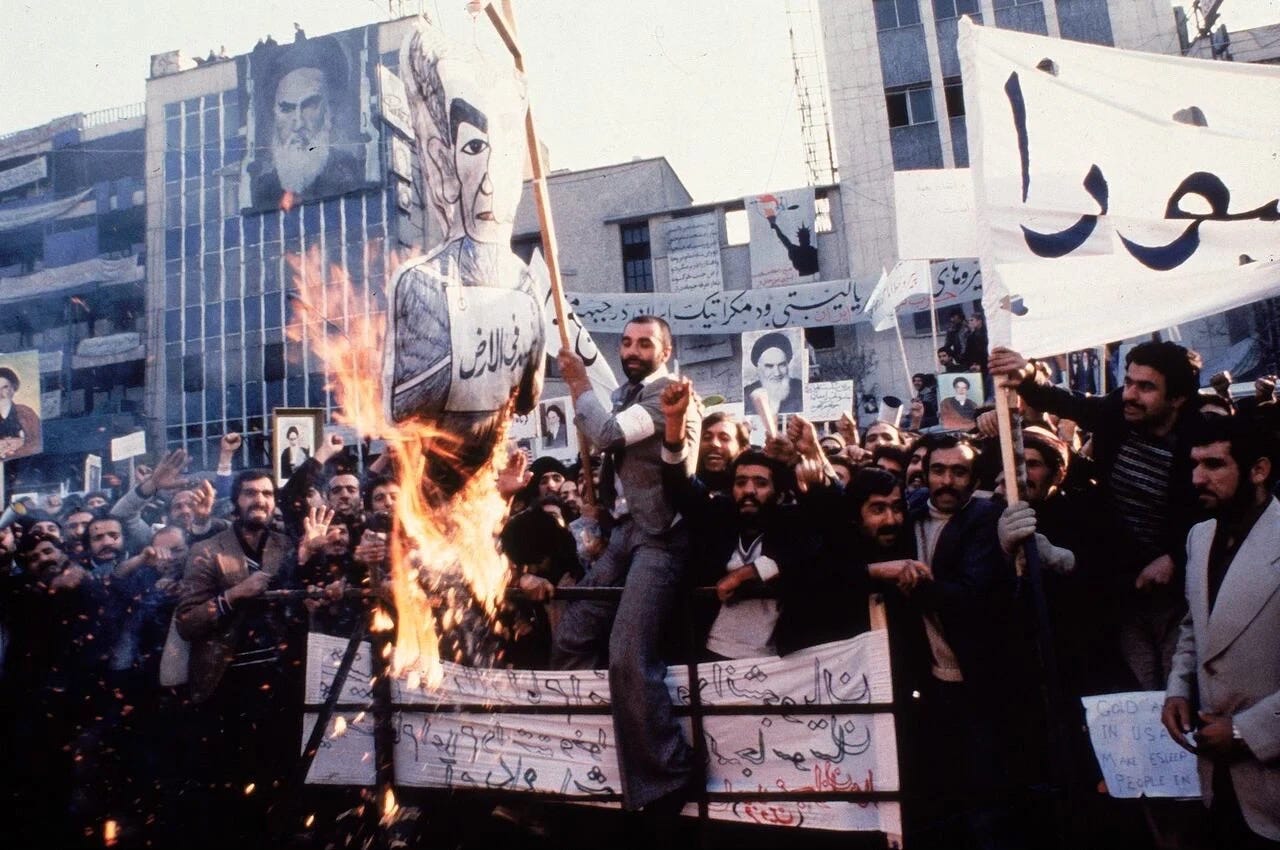
The 1953 coup had written it for him. A savvy political operator, Khomeini fused popular discontent with the government with a coherent ideology appealing to the Shia majority of Iran into a movement that overthrew the Shah and established a theocratic government. The revolution replaced a pro-Western secular monarchy with an anti-Western Islamic republic. The hostage crisis that followed was a direct statement of defiance against the United States, and Khomeini used it to consolidate power at home by delegitimizing moderate opposition leaders who opposed taking the hostages.
The Islamic Republic built its foreign policy around the lesson of the 1953 revolution: never be vulnerable again. The Iran-Iraq War of the 1980s, in which the United States backed Saddam Hussein, killed hundreds of thousands of Iranians and deepened the siege mentality that has defined the regime ever since.
Iran began funding proxies in the early 1980s, and built a regional network of proxy forces in Lebanon (Hezbollah), Iraq (PMF), Yemen (Houthis), Palestine (Hamas), and Syria. The proxy network was a strategic hedge that gave Iran the ability to impose costs on adversaries without direct confrontation. It worked. For decades, Iran projected power across the region without ever facing a direct military conflict after the Iran-Iraq War.
That logic has been dismantled over the last few years. Hamas and Hezbollah have been destroyed as military forces. Assad is gone. Qassem Soleimani, the Iranian general who built and ran the proxy network, was assassinated by the United States in 2020. The hedges Iran spent forty years constructing have been stripped away one by one.
Oil remained the economy’s vulnerability throughout. Every time the West wanted to punish Tehran it reached for oil sanctions. The United States imposed its first sanctions on Iran in 1979. They have never fully been lifted, strengthened under Obama as leverage for the eventual 2015 nuclear deal, and reimposed by Trump when concerns about Iran’s nuclear program resurfaced.
Iran’s nuclear ambitions are inseparable from this history. The nuclear program began under the Shah with American assistance under Eisenhower’s Atoms for Peace initiative. After the revolution it was restarted. The central logic was straightforward: nuclear states are not attacked. The JCPOA of 2015 offered sanctions relief in exchange for enrichment limits.
President Trump withdrew the U.S. from the agreement in 2018 and Iran resumed enrichment. This reinforced that Western commitments are reversible. Earlier this year, Iran offered significant limitations to its nuclear program in negotiations. Shortly after, it was attacked. The conclusion Iran draws from that sequence is that it needs to develop its nuclear and military capabilities faster, not slower.
Iran is now absorbing thousands of airstrikes with its supreme leader dead and its navy destroyed, and it is still holding the Strait of Hormuz closed. This is not irrational behavior. It is the behavior of a country acting from a very long memory, and of a state in a battle for survival using every tool at its disposal. The strait is the one lever Iran has learned, over seventy years, concentrates Western minds: disruption of the oil supply. It is local to Iran, easy to contest, and extraordinarily costly for the U.S. to attempt to reopen.
The country fighting back is not a random adversary. It is a nation shaped by a specific history of having its sovereignty stripped and its resources taken. As one of the world’s oldest civilizations, with a national identity stretching back through a succession of dynasties to the ancient Persian empire, that history ties into a level of national pride that makes resistance particularly salient. Iranians do not need to support the Islamic Republic to resist foreign intervention. The two things are not the same, and they never have been.
That history does not disappear when the bombs stop falling. It will shape whatever government emerges from this war, and whatever relationship Iran has with the West afterward. The question that started all of this, who owns the oil, has still not been answered to Iran’s satisfaction. It is unlikely to be settled by airstrikes.