


A few weeks ago, millions of Americans watched a very unique Super Bowl halftime show. The performance was largely in Spanish, featuring Bad Bunny, a Latin rapper who is the most popular artist in the world. The visuals centered Puerto Rican and Latin American identity. What is usually treated as a neutral entertainment spectacle became the focus of a cultural and political debate. It seemed new because Latin and Spanish language pop is already very popular in the United States but large swathes of the country are not plugged into this.
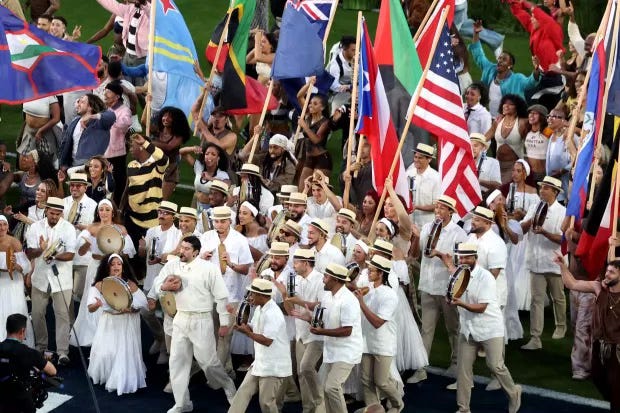
The controversy was not just about one song. It was about the entire halftime show. Bad Bunny’s set was largely in Spanish and centered Latin American culture at a moment of visible tension in U.S.–Latin American relations. Washington has returned to a more assertive posture in the hemisphere, from pressure campaigns against Nicolás Maduro to an aggressive deportation policy at home. Whether framed as security or democracy promotion, that posture revives older memories of intervention.
When Ricky Martin joined the stage to perform “Lo Que Le Pasó a Hawaii,” the meaning was direct. The title translates to “What Happened to Hawaii.” The song draws a parallel between Hawaii’s path from independent kingdom to U.S. annexation and eventual statehood, and Puerto Rico’s current territorial status. Its warning is not about formal statehood alone, but about gradual loss of control over land, political autonomy, and long-term direction under American sovereignty.
That comparison only makes sense if you go back to 1898.
In the aftermath of the Spanish–American War, the United States acquired both Hawaii and Puerto Rico. Hawaii’s monarchy had been overthrown in 1893 by American and European business interests backed by U.S. Marines. Annexation followed five years later. A joint resolution by the U.S. Congress apologizing for this action was passed in 1993.
Puerto Rico was ceded by Spain under the Treaty of Paris ending the war, in addition to Cuba, Guam, and the Philippines. This was part of a broader turn toward overseas expansion marking a break from the earlier continental model of territorial growth. Both island nations entered the twentieth century under American control, strategically valuable and politically unsettled.
Hawaii’s location made it central to Pacific naval power. Puerto Rico became a key foothold in the Caribbean. In both cases, Congress had to decide whether these new possessions were destined for full incorporation into the Union or something else. The Supreme Court addressed that question in the Insular Cases, establishing the doctrine of “unincorporated territories.” The Constitution, the Court held, did not automatically apply in full to newly acquired territories. That doctrine still governs Puerto Rico today.
From there, their paths diverged.
Hawaii moved gradually toward incorporation. It became an organized U.S. territory in 1900 and, after decades of political lobbying and demographic change, achieved statehood in 1959. Statehood brought representation in Congress and participation in presidential elections.
It also locked Hawaii firmly into the federal system. Indigenous land claims were marginalized, large portions of land shifted into corporate and mainland ownership, and the economy became closely tied to tourism and the U.S. military. Political equality within the Union came with permanent integration into American sovereignty.
Puerto Rico followed a different model. It became an unincorporated territory in 1900 and later the Jones Act of 1917 granted U.S. citizenship to residents but not full political rights. In 1952, it adopted a constitution and became a commonwealth, a status designed to provide internal self-government while preserving U.S. authority.
Its residents are U.S. citizens and their children are natural-born citizens, yet they cannot vote in presidential elections and lack voting representation in Congress. The island governs itself locally, but federal law overrides local decisions, and Congress retains ultimate control. It is neither a state nor an independent nation.

The United States has long described itself as anti-imperial, especially in contrast to European colonial empires. Yet Hawaii and Puerto Rico were products of an openly expansionist period. The debate at the time was explicit. Figures such as Mark Twain and perennial presidential candidate William Jennings Bryan opposed annexation, arguing that ruling distant populations without full consent contradicted republican principles. Others maintained that strategic expansion was necessary for economic growth and security. The system that emerged was a compromise that avoided formal colonial language while preserving federal authority over distant territories.
Puerto Rico’s status has never been fully settled. Several referenda have asked voters to choose among statehood, independence, or continuation of the current arrangement, and the results have been divided. Congress has not taken definitive action. In the meantime, economic crises, the imposition of a federally appointed fiscal oversight board, migration to the mainland, and changes in property ownership have reshaped the island’s future without resolving the constitutional question.
“What happened to Hawaii” refers to a specific trajectory: annexation, incorporation, demographic transformation, and permanent integration into the federal system. For some Puerto Ricans, the concern is not simply whether the island becomes a state. From a political standpoint, it is whether decisions about land, the economy, and politics shift steadily toward Washington without a clear and binding settlement of status. From a cultural standpoint, it’s a question of the loss of identity.
The halftime performance did not create that debate. It placed it in front of a national audience. If Hawaii represents full incorporation into the Union and Puerto Rico represents prolonged territorial ambiguity, the comparison forces a basic question about how the United States understands territories acquired during its period of overseas expansion. And it should inform the sensitivity with which the U.S. should approach its new found concern for Latin America and the Western Hemisphere.