


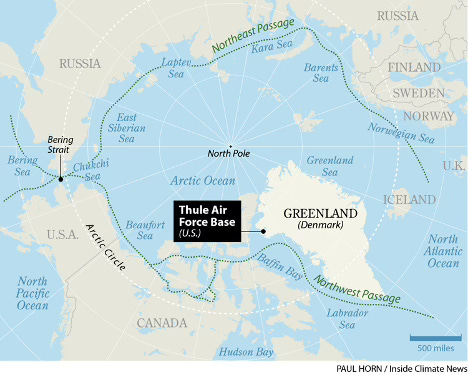
Yesterday, I was revisiting one of my group projects from my Harvard master’s capstone course, where four of us developed a case study on U.S. policy toward Greenland. Our task was to analyze how Washington could respond if China gained access to Greenland’s mineral reserves and a foothold near Pituffik Space Base (formerly Thule Air Force Base), the core of America’s missile warning network.
That project reminded me how quickly the Arctic has moved from the edges of the map to the center of global politics. I addressed the strategic importance of the Arctic in a previous post, but there is more to it than that. What once seemed like a remote research topic now feels like a preview of the world we’re entering: where climate change, security, and technology are all colliding in real time.
The Arctic is warming nearly four times faster than the rest of the planet. What was once a frozen frontier is now a crossroads of climate change, global rivalry, and new technology. The ice is disappearing, and with it the idea that the far north is distant or unchanging.
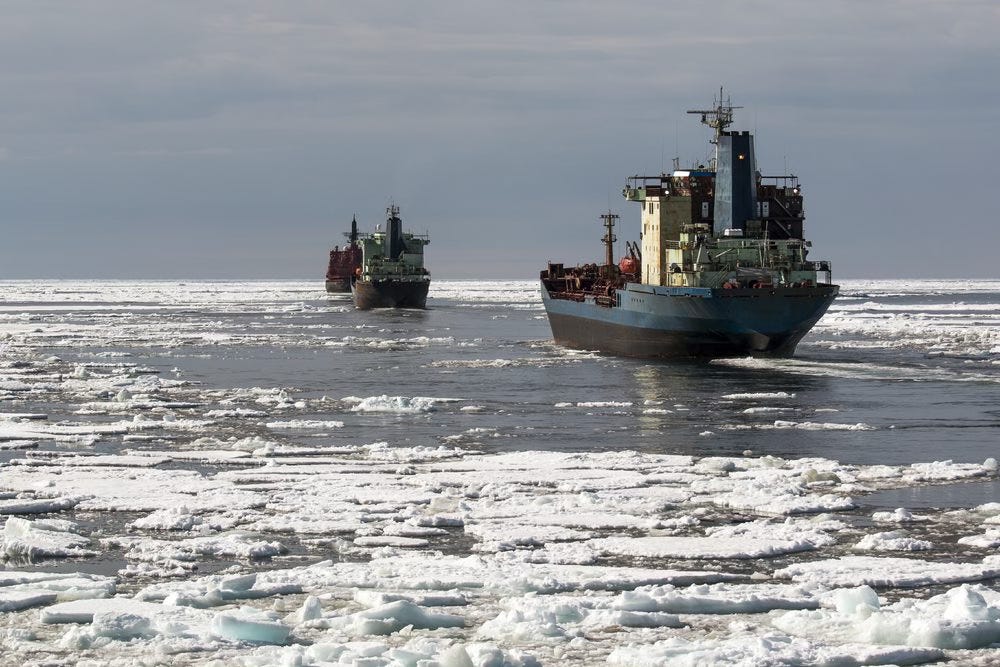
Of course, you can dispute that this climate change is man-made, or, to a lesser extent, that climate change is happening in the first place. What you can’t dispute is the reality that the extent of summer sea in the Arctic is retreating and opening new shipping routes are opening across the top of the world. Governments and the private sector are responding to this reality.
The Northwest Passage along Canada and Greenland and Russia’s Northern Sea Route are now seasonally open, cutting travel time between Asia, Europe, and North America. Whoever writes the rules for these waters will shape the future of global trade. The melt is also revealing untapped mineral resources.
A Danish study found that Greenland holds nearly all 38 minerals the EU lists as critical, including rare earths and uranium used in batteries, chips, and clean energy. The United States and China are both trying to secure influence. Washington wants reliable supply chains, while Beijing talks of a “Polar Silk Road.”
Technology is central to this. In northern Greenland, Pituffik Space Base serves as a U.S. hub for missile defense and satellite tracking. Its location makes it valuable for both security and communication. Russia has expanded its military bases on its Arctic coast, and NATO has increased patrols. The Arctic is no longer a blank spot on the map. It is connected to the world’s defense and data systems.
It is also becoming a testing ground for new climate technology. A British startup recently tried to refreeze sea ice by pumping seawater onto its surface. The goal was to thicken the ice and reflect more sunlight, slowing the pace of melting. This type of geoengineering involves deliberate attempts to alter the climate.
Other proposals include spraying particles into the sky to brighten clouds or placing floating barriers to slow melting glaciers. Supporters see these methods as a way to buy time if emissions reductions fall short. Critics warn that they could disrupt weather and harm Arctic ecosystems in unintended ways. The technology is moving ahead faster than the rules governing it.
All of this makes the Arctic a place where climate, diplomacy, and technology collide. Security here is not only about icebreakers or submarines. It is also about who controls minerals, satellites, and the ability to change the planet’s temperature.
Yet global rules remain unclear. There is no treaty on geoengineering, and countries still dispute whether the Northwest Passage is an international route or Canada’s own waters. China now calls itself a “near-Arctic state.” Russia continues to build up its coastline. The United States is trying to keep Denmark close to prevent Greenland from drifting toward Beijing..
And for the rest of us, the consequences are not far away. Greenland’s minerals could affect the price of electric cars. The new sea routes could change shipping costs. And experiments with climate technology in the Arctic could influence weather around the world.
The Arctic is no longer remote. It is becoming a mirror for the choices humanity faces about energy, power, and the planet itself.