


On July 4, 2026, the United States turns 250. The ceremonies are already planned. What is less certain is whether the occasion will answer the question it implicitly raises, which is not about what the country has accomplished but about what it is, what idea holds it together, and what it stands for. The answer has been contested since the founding, but the current moment gives it much more weight.
Lincoln’s Lyceum Speech and the Threat from Within
In 1838, Abraham Lincoln was 28 years old and unknown outside Illinois. He delivered a speech in Springfield to a local civic organization about American politics. His central point was the U.S. would fail as a republic because of internal division, not invasion.
“Shall we expect some transatlantic military giant, to step the Ocean, and crush us at a blow? Never! All the armies of Europe, Asia and Africa combined . . . could not by force, take a drink from the Ohio, or make a track on the Blue Ridge, in a trial of a thousand years. At what point then is the approach of danger to be expected? I answer. If it ever reach us it must spring up amongst us. It cannot come from abroad. If destruction be our lot, we must ourselves be its author and finisher. As a nation of freemen, we must live through all time, or die by suicide.” - Abraham Lincoln’s Lyceum Address, January 27, 1838.
He had two things in mind for what these internal problems could be. The first was erosion of respect for the law and a slow hollowing out of institutions. The second was that an ambitious person, talented and restless, would build when the opportunity was there and tear down when it was not.
If that person rose up in a successful, democratic society, they would distinguish themselves by tearing it apart. Lincoln was pointing to a vulnerability built into democratic government. Holding it in check required a shared civic idea that everyone, including the ambitious, was measured against. The question was what that idea was.
Lincoln’s Constitutional Philosophy: The Declaration as the Key
The Constitution was widely read in Lincoln’s time as a contractual arrangement between sovereign states. They had ceded certain powers to a federal government while maintaining sovereignty elsewhere. A state could in theory reclaim those powers, which is what Southern states argued when they seceded. Lincoln rejected the premise.
His argument, developed most fully during the Lincoln-Douglas debates, was that the Constitution could not be properly read apart from the Declaration of Independence. The claim that all people are created equal, and that government derives its authority from the consent of the governed, was the founding idea the Constitution existed to protect. Everything else followed from it. It was not just a “contract”.
This was the basis of his opposition to expanding slavery to newly admitted states, the position the Republican Party was formed around. The objection was that spreading it into new territories violated the document the country was founded on. The Constitution did not prohibit slavery, but the imperative to protect life, liberty and the pursuit of happiness, which the Declaration said was the goal of government, could not coexist with treating human beings like property.
This is the civic religion Lincoln was defending: not Christianity, not shared ancestry, not a particular culture, but a claim about human equality and what government is for. It functions as a national idea because it does not exclude anyone in advance. It derives from a universal idea about human beings, not a particular claim about any group of them.
What Replaces It: Alternatives That Cannot Hold
When that framework is set aside, something moves in to replace it. One of the most prominent candidates today is a politics rooted in religious identity. Christian Nationalism holds that the United States is and should be understood as a Christian nation, that its laws should reflect Christian values exclusively, and that its legitimacy derives from that religious foundation.
A civic idea that functions as a national foundation must be available to every person. One grounded in a specific religious identity cannot be. A Jewish American, a Muslim American, an atheist American: each holds full citizenship according to the Declaration and none holds full citizenship under a framework that ties legitimacy to Christian identity.
Without a shared foundation, what remains is a contest over power. Each faction claims legitimacy for itself and denies it to the other. There is no common ground to appeal to and no shared principle to resolve disputes. Force fills the space that principle vacated.
The Visible Fragmentation
The evidence of this breakdown is already present. California sets its own environmental standards, its own immigration enforcement, and now is setting its own trade relationships. Texas does the same from the opposite side of the aisle. Redistricting has become a national partisan battle between democrats in blue states and republicans in red states.
The country is functioning less like a union and more like a loose collection of competing regional governments. The political rhetoric tracks this reality. A president in the American tradition governs all citizens. The current posture dispenses with that premise. Political opponents are not adversaries to be defeated at the ballot box. They are enemies, internal threats, and targets for punishment.
That rhetoric carries consequences beyond the ballot box. When a president and his movement cast the opposition as enemies of the country, use the powers of the office to pursue political opponents, and govern by division rather than by any pretense of representing everyone, they create an environment in which people on both sides feel genuinely threatened.
People who feel threatened respond, often in ways that are morally indefensible. The rise in political violence and the assassination attempts of recent years did not emerge from nothing. The shock expressed when this happens is not credible from a movement that stokes fear and anger, or at least looks the other way when their leaders do so.
“For they sow the wind, and they shall reap the whirlwind” – Hosea 8:7.
The Strains That Are Outside the Tradition
The ethno-nationalist and Christian nationalist currents now present in American politics are different expressions of the same underlying position: that political legitimacy derives from identity or ancestral culture rather than shared principles. Both place themselves outside the Lincoln tradition. If legitimacy flows from who you are rather than from a universal claim about human beings, it cannot simultaneously flow from the Declaration of Independence.
Ethno-nationalism has few native roots in the American political tradition. Its genealogy has more in common with European nationalist and monarchist movements. The aesthetic of the current moment reflects this. Gold-plated offices, the president’s name and likeness on consumer goods, passports, and portraits accumulating across federal buildings. This has a different point of origin than the republic whose first president refused a crown.
These movements are not advancing an argument for something better. They are pulling down because pulling down is the end itself. Lincoln identified the type in 1838, and Francis Fukuyama described the same impulse in The End of History. The check Lincoln identified was a country unified around the shared idea. The question is whether enough of that unity remains.
“Experience suggests that if men cannot struggle on behalf of a just cause . . . then they will struggle against the just cause. They will struggle for the sake of struggle. . . . for they cannot imagine living in a world without struggle. And if the greater part of the world in which they live is characterized by peaceful and prosperous liberal democracy, then they will struggle against that peace and prosperity, and against democracy.” - The End of History and the Last Man by Francis Fukuyama
The Other Temptation: Exclusion
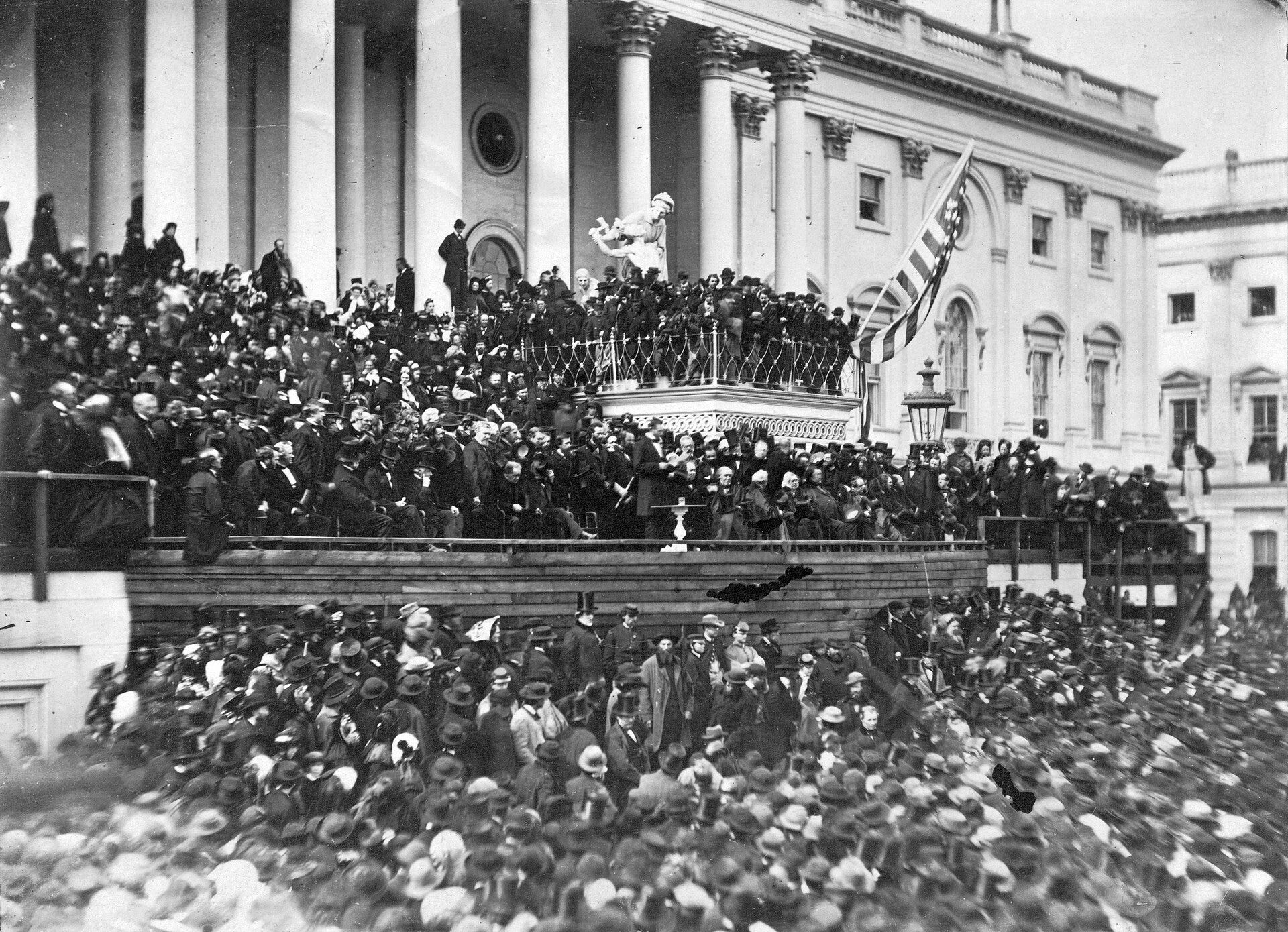
The civic tradition cuts both ways, and the opposition to these ideologies has its own failure to account for. Lincoln concluded a war that killed hundreds of thousands and then chose reconciliation over punishment. His second inaugural address spoke of shared guilt for slavery and war, and national peace and unity.
Many of the people who found the nationalist argument persuasive are not true believers. Some felt their concerns were dismissed as ignorant or malicious, watched a political coalition treat their exclusion as a feature and then found themselves drawn to anyone who acknowledged their anger. Some also voted for the traditional policy positions they agree with.
Treating those people as permanent enemies rather than as fellow Americans to be brought back to a common foundation does not protect the civic tradition. It concedes the nationalist argument that the other side is simply another tribe pursuing its own interests.
The Civil War killed over half a million Americans. The country reconciled anyway, imperfectly but enough to function as a union again. If that was possible after four years of industrialized killing between Americans, the current division is small in comparison. But, it won’t happen by treating everyone who voted differently as an enemy.
“With malice toward none, with charity for all, with firmness in the right as God gives us to see the right, let us strive on to finish the work we are in, to bind up the nation’s wounds, to . . . achieve and cherish a just and lasting peace among ourselves and with all nations.” - Second Inaugural Address of Abraham Lincoln, March 4, 1865
What Is at Stake
Lincoln’s civic religion is either the country’s operating principle, or it is not. Either the government’s authority derives from the idea that all people are created equal, with everything that requires in practice, or it derives from something else: identity, force, or the preferences of whoever controls the government at a given moment.
If the framework is discarded, what remains is competing power claims with no common reference point, which is the condition Lincoln identified in 1838 as the precondition for the republic’s end. The 250th anniversary is a reasonable occasion to ask whether our inheritance can still hold.