


Guest contributer Armin Aryafar writes on defense procurement, emerging technology, and geopolitics. He is an FAA-certified UAS operator working in autonomous drone delivery, and this piece draws on his current research on UAS and transportation planning.
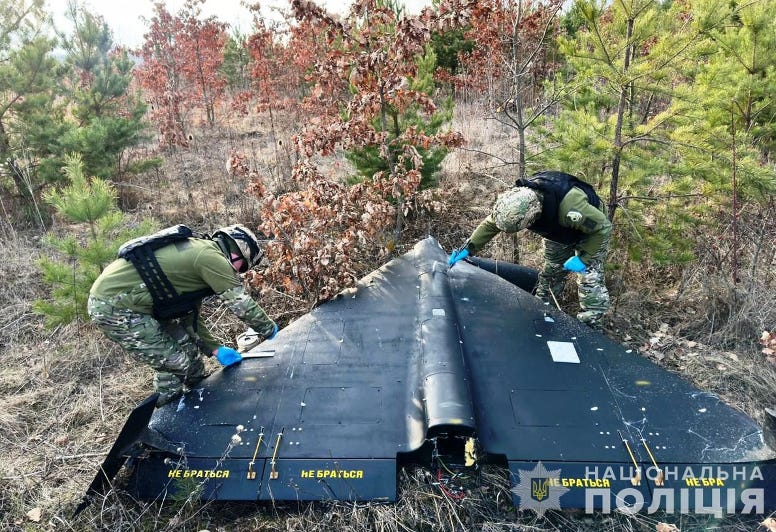
The United States military remains the most powerful in the world. Yet the inflexibility of its industrial base to adapt to the current pace of armed conflict is concerning. The American public is not prepared for the consequences if procurement does not fully adopt the lessons learned in Ukraine. A $20,000 drone is reshaping 21st-century warfare. The U.S. still doesn’t have a good answer to it.
In 2025 alone, Russia launched 54,538 Shahed-type drones against Ukraine. These are not sophisticated weapons. They cost between $20,000 and $70,000, cheap enough to use as disposable missiles and simple enough to mass produce. They are made partly from Western microchips and Canadian satellite antennas, smuggled through shell companies in the UAE and Central Asia despite international sanctions.
Early in 2025, only 2–3% of them hit their targets. But by December that hit rate had climbed to as high as 28%. Ukraine’s air defenses, meanwhile, were being ground down by the sheer volume of these cheap one-way suicide drones. Through all this, Ukraine adapted, while the United States watched.
The Paradox at the Heart of American Defense
The United States leads the world in aerospace technology. It invented the drone. It operates the Reaper, the Global Hawk, and is developing collaborative combat aircraft that can fly alongside manned jets and make autonomous decisions. In terms of high-end unmanned systems, no country comes close. The Patriot missile defense system, though now over 40 years old, is still one of the best systems used across the globe for missile defense. But the U.S. still uses a procurement system mired in bureaucracy.
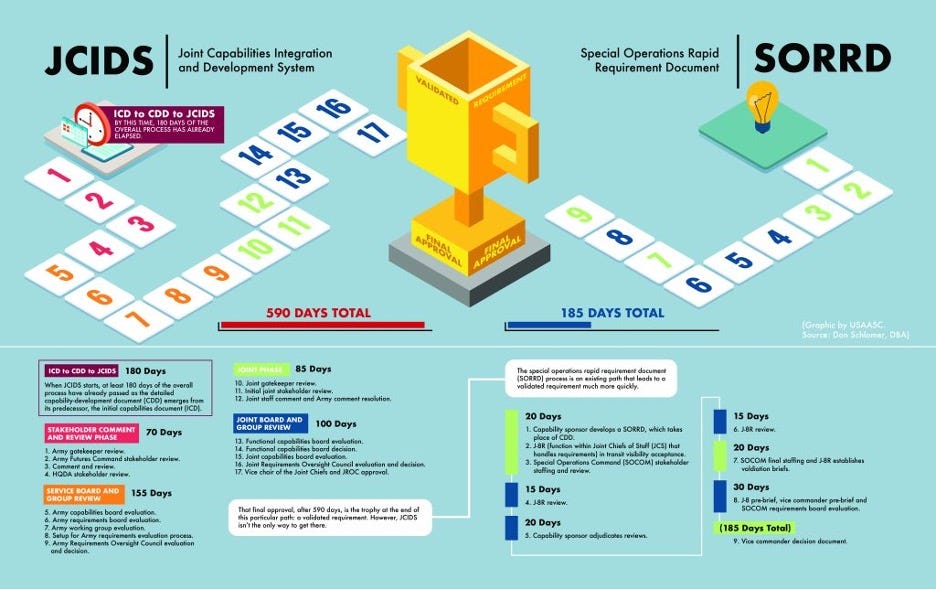
Every major U.S. weapons program starts with JCIDS: the Joint Capabilities Integration and Development System. The military must define exactly what it needs in exhaustive detail, a process that takes one to two years on its own. Then come three formal milestone gates requiring approval from senior Pentagon leadership and notification to Congress, followed by years of testing and evaluation before production begins.
For a fighter jet or an aircraft carrier, this makes sense. These are systems that cost billions and will be in service for fifty years. You want to get them right to stave off early retirement and reduce maintenance and upkeep costs. For a drone that costs $40,000 and will be used once, the same cumbersome process currently applies.
The Federal Acquisition Regulation System, the rulebook that governs all government purchasing, is so complex that it effectively favors large, established defense contractors who have entire legal departments dedicated to navigating it, over the small startups that are building innovative drone technology today.
Five Countries, Five Approaches
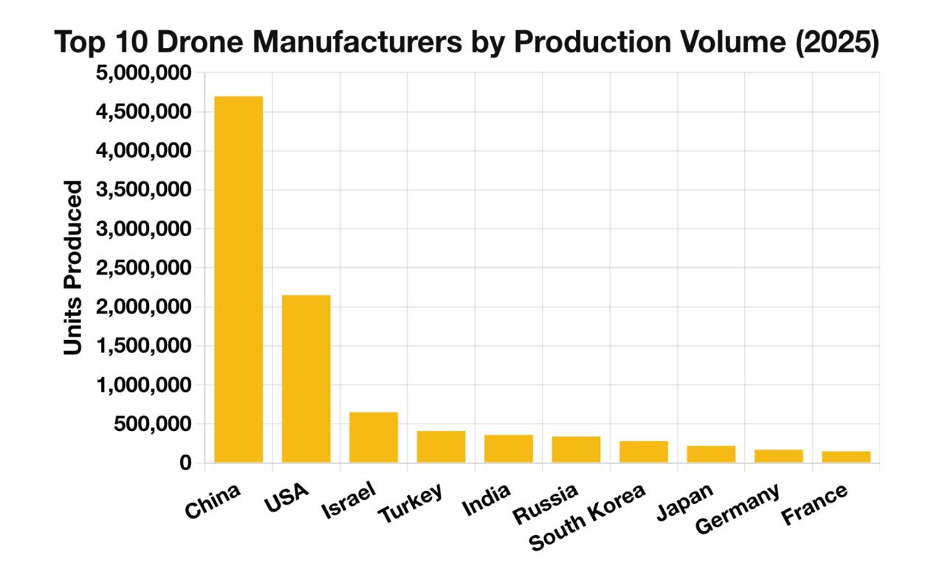
Drones are dual platform technology, and countries which can produce the largest quantity of them have an advantage.
Russia chose state-directed industrial mobilization. Its main factory now produces roughly 5,500 Geran-2 drones per month, heavily based on the Iranian Shahed design. The unit cost has fallen from around $200,000 when Russia imported them from Iran in 2022 to roughly $70,000 for domestically produced versions in 2025. This is a war economy running full steam ahead and virtually no oversight exists.
Iran has shown that you don’t need a sophisticated industrial base to win the strategic calculation. The Shahed drone was designed around a simple idea: a $20,000–$50,000 drone that forces the defender to shoot a $5 million interceptor missile is extracting value regardless of what it hits. Under heavy Western sanctions, Iran still managed to supply Russia with drone technology by sourcing components through the UAE, China, and Central Asia. In the current conflict with the U.S. and Israel, the lesson from Iran is you don’t need to build the best drone, you need to build one cheap enough to use as a weapon of attrition.
China operates at a different scale entirely. Its Military-Civil Fusion policy breaks down the barrier between commercial technology and military procurement. DJI, the company that makes the small, commercially available drones, holds over 90% of the global civilian drone market. That is directly convertible military capacity in the event of a war required a major scale-up in military drone production.
Turkey built and fielded the Bayraktar TB2, a combat-proven armed drone that has performed in Syria, Libya, Azerbaijan, and Ukraine, in roughly five to seven years from first prototype to fielded system. The unit cost is around $5–5.5 million, compared to roughly $30 million for the U.S. MQ-9 Reaper.
And then there is Ukraine,where survival eliminated bureaucratic friction entirely. When Russia invaded in 2022, Ukraine had seven drone manufacturers. By 2025 it had over 500, producing four million drones annually,more than any NATO country). Ukraine built interceptor drones costing $1,000 to $3,500 per unit designed to destroy Shaheds. Ukraine produced 100,000 of them in 2025. One startup went from founding to battlefield deployment in seven months. Private companies-built prototypes, soldiers tested them, feedback arrived in days, and production scaled accordingly, in a cycle taking only weeks.
The Reforms Are Real But Are They Enough?
The Biden and Trump administrations have not ignored this problem. Recent reforms represent the most significant structural changes to U.S. drone procurement in decades.
In June 2025, an executive order directed federal agencies to promote domestic drone production and removed some restrictive legacy policies. In July 2025, the DOD issued a memo giving colonel-level commanders the authority to procure and test small drones, a meaningful cultural shift away from the Pentagon’s centralized approval structure.
The Drone Dominance program commits $1 billion toward 340,000 drones delivered over four competitive phases. Phase I launched at Fort Benning in February 2026, with 25 vendors competing to hit a target unit cost of around $5,000. The Army’s Pathway for Innovation, launched in November 2025, is explicitly designed to allow servicemembers to define defense acquisition requirements.
These are real steps, just not enough of them. Even at the Drone Dominance’s programs most ambitious scale, 340,000 drones over two years, that is 170,000 per year. Russia launched 54,538 in a single year against one country. China’s estimated production capacity is 500,000 per month.
A Brave New Warfare
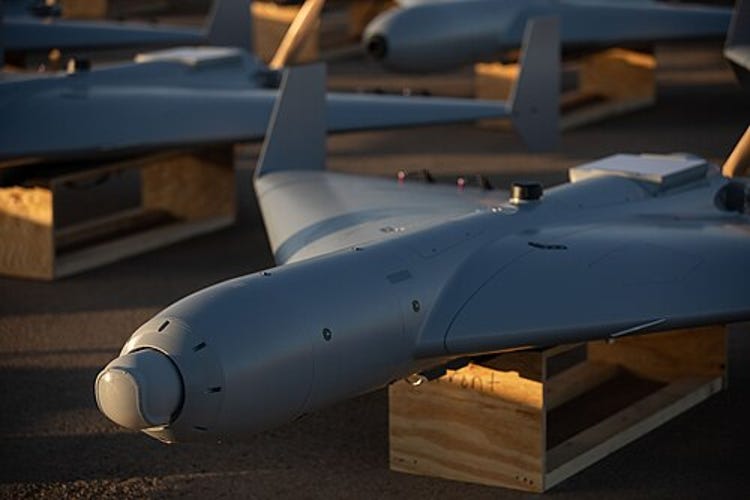
One way attack drones represent a meaningful shift in American procurement. At roughly $22,000 per unit, they mirror the cost logic of the Iranian Shaheds they are designed to counter. But drone warfare demands a networked approach: attack, intercept, surveil, and jam operating as a system rather than isolated platforms. The F-35 was built around network centric warfare. American drone doctrine needs the same integrated thinking applied to these low-cost systems.
A new industrial base needs to be built, and the procurement system needs to change. Congress needs to decide what level of oversight is appropriate for systems that cost less than a new car. Slower doesn’t just cost our country dollars, it will cost our soldiers’ lives and our military’s effectiveness in a world where quantity has won out against expensive weapons systems.
Guest contributer Armin Aryafar writes on defense procurement, emerging technology, and geopolitics. He is an FAA-certified UAS operator working in autonomous drone delivery, and this piece draws on his current research on UAS and transportation planning.
