


Four years into Russia’s full-scale invasion of Ukraine, the broad outlines of the war’s trajectory are becoming clear. The battlefield has been static, grinding through fortified positions in the east while both sides absorbed casualties at a rate unseen in Europe since the Second World War. That picture is changing. Ukraine’s drone industry has matured into something Russia did not anticipate and has not been able to counter, and the effects are now concentrating on the one territorial objective Russia achieved.
Russia entered this war with maximalist objectives. The plan, as best as outside analysts could reconstruct it, was to topple the Zelensky government, install a compliant replacement, annex most of the country’s west, and leave behind a rump state cut off from the Black Sea. Those objectives collapsed within weeks of the February 2022 invasion.
What Russia actually achieved was much narrower: a contiguous land corridor connecting the Russian mainland to Crimea, secured through the annexation of four oblasts (or states), Donetsk, Luhansk, Zaporizhzhia, and Kherson, that form its geographic foundation. That corridor was the war’s one durable Russian achievement. Ukraine is now systematically destroying it.
The Ukrainian Land Bridge
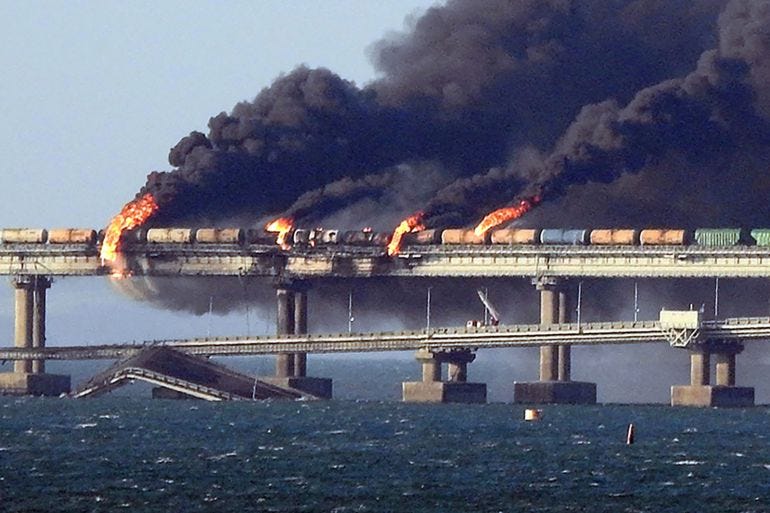
The corridor’s origins predate the full-scale invasion. Russia annexed Crimea in 2014 and built the Kerch Strait Bridge to connect the peninsula directly to the Russian mainland. The bridge was symbolic as much as practical, personally inaugurated by Putin in 2018. It was also a single point of failure. But the catch is a peninsula supplied through one bridge is a peninsula under permanent strategic threat. The land corridor through occupied southern Ukraine was the answer to that problem.
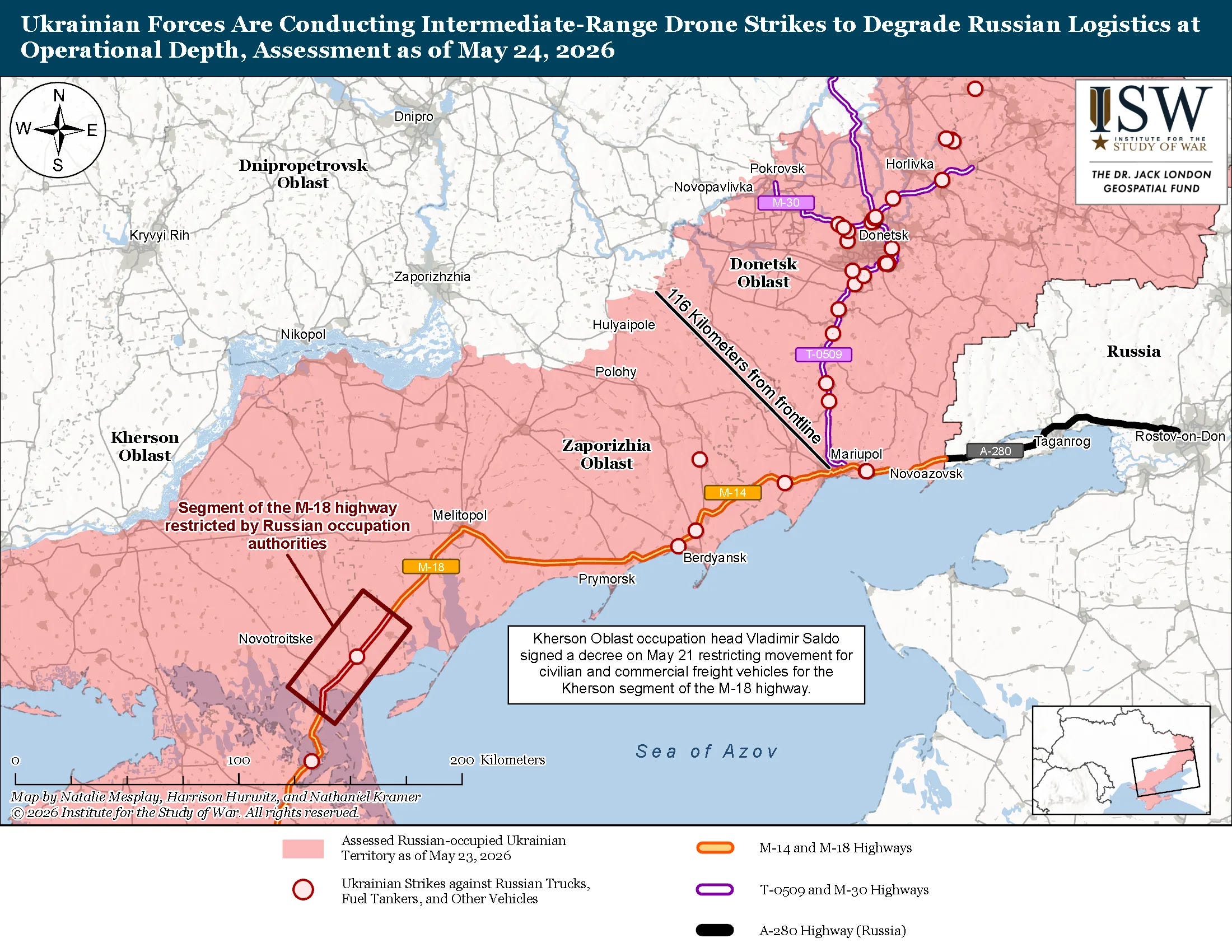
Russia invested heavily in making the corridor work. The overland route runs over 300 miles linking the Donbas region to the Crimean rail network, passing through several large Ukrainian cities. Russia has spent billions on roads, railways, ports, and industrial projects across occupied southern Ukraine. The logic was sound: no single strike could sever a distributed road and rail network the way a missile could close a bridge. By mid-2024, Russia had largely stopped using the Kerch Bridge to move military equipment and shifted to these overland routes instead.
Ukraine’s drone program was not, in the early years of the war, capable of threatening that network. Through 2023 and into 2024, Ukrainian systems could hit targets near the front but lacked the range and numbers to interdict supply lines deep in occupied territory. Russia’s distributed road network was, for a time, genuinely difficult to attack.
That changed as Ukraine’s domestic drone industry matured and new systems entered service. The Hornet drone, equipped with Starlink-enabled connectivity and AI-assisted targeting, can now penetrate well behind Russian lines. Cheaper FPV drones have also extended their effective range to 100 kilometers (62 miles). Earlier in 2026, Ukraine used FP-2 drones to suppress Russian air defense systems across occupied territory, opening the airspace for the attack on the overland route that followed.
The “Highway to Hell”
The results are now documented. The Ukrainian Defense Minister described the operation as a “logistics lockdown” as of late May 2026, with more than 125 trucks destroyed. One vehicle was reportedly struck near the Mariupol-Rostov highway, roughly 150 kilometers (93 miles) behind the front lines. Multiple routes on the same network Russia spent years and billions constructing are under attack. Russian occupation authorities have responded by restricting civilian movement on portions of the Crimea road. Ukraine’s stated targeting priority as of April 2026 is strikes at depths of 120 to 150 kilometers to slowly choke off the viability of this corridor.
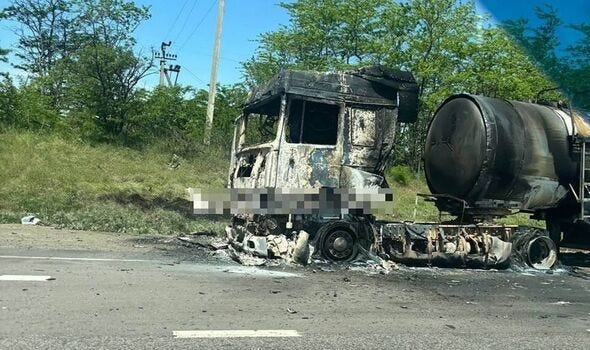
The battlefield consequences are becoming visible. Russian troops in the Kherson and Zaporizhzhia regions are particularly exposed because their supply system runs almost entirely through the corridor. Every destroyed fuel truck and delayed ammunition shipment degrades the combat power of forces already holding heavily fortified but thinly supplied positions. Movement is now occurring on the southern line.
Ukraine is taking fortified Russian positions, and Ukrainian commanders have struck a bullish tone about a coming operational shift. Russia has adapted to Ukrainian tactics before and will attempt to do so again and has made limited advances in some areas itself over the last month. The question is whether Ukraine can sustain the interdiction rate long enough to convert supply degradation into a genuine breakthrough before that window closes.
Russia Backed Into a Corner
Russia’s response has followed its established pattern. It struck Kyiv with Oreshnik hypersonic missiles capable of carrying nuclear warheads, hitting targets with no discernible military value. It staged large-scale nuclear drills in Belarus, training tens of thousands of personnel. These are signals directed at NATO as much as at Ukraine, and they are not working as intended.
France announced in March 2026 that it would extend its nuclear deterrence framework to willing European partners. Norway joined on May 27 as the ninth member, alongside Belgium, Denmark, Germany, Greece, the Netherlands, Poland, Sweden, and the United Kingdom.
France retains sole authority over any launch decision, making the arrangement more about deterrence than sharing nuclear weapons. But as a signal it is significant: Europe is assembling a security architecture that does not depend on America, and Russian escalation theater is the reason. If Russia fails in Ukraine, it has nowhere to turn but inward.